AI Baby Name Generator vs Traditional Methods: Which Works Better?
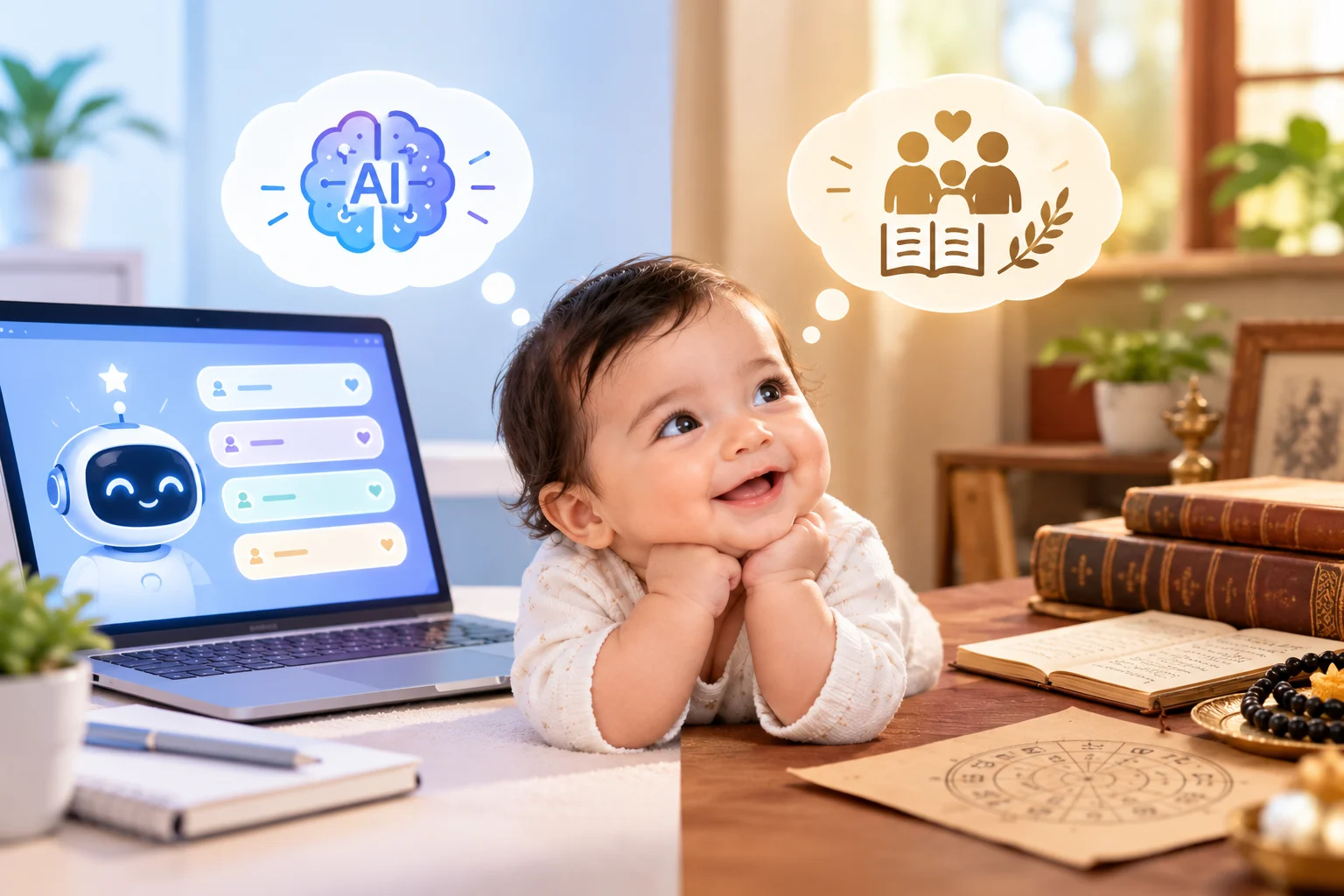
Neither works better in every case. An AI baby name generator is faster and offers broader, more tailored name ideas. Traditional methods, such as family naming customs, name books and relatives' input, carry heritage and personal meaning that AI cannot supply. Most parents get the best result by using AI to generate ideas and traditional methods to decide.
For generations, parents chose names by asking relatives, flipping through a name book, following a family custom, or consulting a religious or astrological guide. Now an AI baby name generator can return a themed shortlist in seconds. So which approach is actually better?
The answer depends on what you need from the process. Speed and variety point one way. Heritage and shared meaning point another. Many parents end up using both without planning to.
This guide compares the two approaches fairly, criterion by criterion. You'll see where an AI baby name finder has the edge, where traditional methods still win, and how to combine them into one practical process.
What Counts as a Traditional Baby Naming Method?
A traditional naming method is any approach that relies on people, printed references or established customs instead of software. These are the most common ones.
• Family and heritage customs. Naming a child after a grandparent, following a naming pattern, or choosing a name from your community's language.
• Name books and printed lists. Reference books that group names by origin, meaning or letter.
• Conversations with relatives and friends. Gathering suggestions and reactions from people you trust.
• Religious or cultural guidance. In some traditions, a priest, elder or astrologer suggests names or starting letters, and a naming ceremony marks the choice.
• Personal experience. Names tied to a place, a story, a book or a memory that matters to you.
These methods are slower, but they carry something a tool cannot invent: a real connection between the name and the people who give it.
What Is an AI Baby Name Generator, and What Does It Add?
An AI baby name generator is an online tool that suggests names from preferences you provide, such as origin, meaning, sound, length or theme. It adds speed, breadth and flexibility. You can describe what you want in plain language, see names from traditions you may not know, and refine the results with each round.
It does not add certainty. Its suggestions come from patterns and available data, so meanings and origins still need checking. Think of it as a very fast brainstorming partner, not a decision-maker.
How Do AI Name Generators and Traditional Methods Compare?
The table compares both approaches on the factors parents most often care about. These are general tendencies, not guarantees, and individual tools and families vary.
|
Criterion |
AI baby name generator |
Traditional methods |
|
Speed |
Results in seconds; easy to repeat |
Slower; depends on conversations and reading |
|
Variety |
Wide, including names from unfamiliar traditions |
Limited to what you, your family and your books know |
|
Personalization |
Responds to style, sound, length and surname in your request |
Personalized by people who know your family |
|
Cultural and family depth |
Limited to what you tell it; needs verification |
Strong, especially for customs and ceremonies |
|
Name meaning accuracy |
Can be wrong or oversimplified; verify |
Varies by source; reputable references and elders can be reliable |
|
Cost |
Many tools are free or low cost |
Books cost money; conversations are free |
|
Emotional meaning |
Comes from you after choosing |
Often built into the process itself |
|
Shared experience |
Can be shared by comparing shortlists |
Naturally shared with family |
|
Risk of overload |
Many options can feel overwhelming |
Fewer options, so less overload |
The pattern is clear. AI leads on speed, variety and convenience. Traditional methods lead on heritage, trust and the emotional weight of the process.
What Are the Strengths and Limits of Each Traditional Method?
Each traditional method solves a different problem. Knowing which one you need keeps you from using the wrong tool for the job.
Family and Heritage Customs
Strengths: they connect a child to relatives, language and community, and they settle many decisions before they begin. Limits: they narrow your options, and expectations from family can add pressure if your tastes differ.
Name Books and Printed Lists
Strengths: they are calm, browsable and good for learning about origins and baby name meanings without a screen. Limits: they are fixed in time and generic. Popularity notes can date quickly, and a book can't respond to what you say you want.
Relatives and Friends
Strengths: they offer honest reactions, including warnings about nicknames or associations you hadn't thought of. Limits: opinions can conflict, and too many voices can make the choice harder.
Religious or Astrological Guidance
In some traditions, a priest, elder or astrologer suggests names or starting letters based on birth details, and a naming ceremony follows. This is a cultural and religious practice, and its value is meaning and continuity for the family. It is not a scientifically proven way to predict a child's future, and it can be respected on those terms.
Strengths: deep cultural meaning and a shared family ritual. Limits: it may restrict choices to a narrow set of sounds, which some parents then widen using other tools.
Personal Stories and Memories
Strengths: a name linked to a place, a book or a person carries meaning no list can supply. Limits: it can be hard to find options that fit a specific story, which is where a descriptive search can help.
When Does an AI Baby Name Finder Work Better?
An AI baby name finder works better when you know the feeling you want but not the name, or when your options feel too narrow. These are the situations where it tends to help most.
• You want themed names. Celestial baby names, mythological baby names or nature names are easy to request and hard to find in a general list.
• You want unique baby names that are still usable. You can ask for uncommon options with limits on spelling and syllables.
• You want gender-neutral names. Gender neutral names, also called unisex baby names, can be requested directly and compared by sound and origin.
• You're checking surname flow. Testing many first names against a long or unusual surname by hand is tedious.
• You're stuck. Even a bad list of suggestions shows you what you dislike, which clarifies what you want.
When Do Traditional Methods Work Better?
Traditional methods work better when the name needs to carry a family story, a religious meaning or a cultural custom. These are the situations where no generator can substitute.
• A naming custom decides part of the choice. Whether it's a relative's name, a starting letter or a ceremony, the tradition sets the frame.
• Heritage language matters. Relatives who speak the language can judge pronunciation, spelling and meaning far better than a tool can.
• You need honest reactions. A grandparent's wince is useful data that software can't provide.
• You want the process to be part of the memory. Many families treasure the conversations, not just the final name.
Which Is More Accurate for Name Meanings?
Neither is automatically more accurate. Name meanings vary by culture, spelling and source, and some etymologies are debated. A reputable reference book or a knowledgeable relative may be more reliable than a tool that states an uncertain meaning with confidence. On the other hand, an AI tool can quickly show several interpretations to compare. Whichever you use, confirm the meaning in at least two trusted sources.
Do They Handle Unique Names Differently?
Yes. Traditional methods tend to produce names within a known circle, which makes them familiar but less likely to feel distinctive. AI can reach further, but uncommon names bring practical costs: pronunciation, spelling and explaining. A useful test is to say the name aloud and imagine spelling it on the phone.
Can You Combine AI and Traditional Methods?
Yes, and it is usually the best approach. Use traditional methods to set the frame and make the final call, and use AI to fill the space between with ideas. A practical approach is to follow these steps.
1. Start with your family. Note any customs, relatives' names, languages or starting letters that matter. These become your rules.
2. Write your top three priorities. For example: meaning, ease of pronunciation and a name that suits your surname.
3. Give the rules to an AI baby name generator. Include origin, style, length and your surname, plus names you love or want to avoid.
4. Collect a shortlist of five to ten names. Save what you like across several rounds.
5. Check the facts the traditional way. Confirm meanings and origins in a reference book or with someone who knows the language.
6. Ask people you trust. Share the shortlist and listen for pronunciation problems, nicknames and associations.
7. Say it aloud and sleep on it. Try each finalist with your surname and middle name. Decide after a few days.
Which Method Fits Your Situation?
|
Your situation |
Lean toward |
Why |
|
A family custom shapes the name |
Traditional methods first, AI for options within the custom |
The tradition sets the frame |
|
You have no starting ideas |
AI first |
Quick, varied inspiration |
|
You and your partner disagree |
AI shortlists, then a family conversation |
Gives you a shared set of options to react to |
|
You want a distinctive name |
AI, then verification |
Reaches beyond familiar names |
|
You want a name from a heritage language |
Traditional guidance, AI for brainstorming |
Native speakers judge sound and meaning best |
|
You're short on time |
AI |
Fast and easy to repeat |
|
You want the process to be a family event |
Traditional methods |
Conversations are the point |
What About Zodiac, Look-Alike and Birthday Features?
Some tools add playful extras. Zodiac names, or astrology-inspired names, are a personal and cultural naming approach, not a scientific method. An AI baby look-alike predictor makes an entertainment-oriented estimate and cannot reliably predict how a real child will look, because inherited traits combine unpredictably. Celebrity birthday matching simply compares a date with public birth records. Enjoy them as fun, but don't let them decide the name.
Explore More With Jollynames.ai
Once you have a better idea of the naming style you love, Jollynames.ai can help you explore more possibilities and discover names that fit your family's preferences. You can brainstorm with an AI-powered naming tool, browse themes such as celestial, mythological or gender-neutral names, and try the baby appearance and celebrity birthday features for a lighthearted extra.
Whatever you find, check the meanings and origins that matter to you, and share your shortlist with the people whose opinions you trust.
So, which works better? An AI baby name generator wins on speed, variety and flexibility. Traditional methods win on heritage, trust and the emotional meaning of choosing together. Neither replaces the other.
The approach that serves most families is a combination: let family customs set the frame, let AI widen the list, then verify facts, ask people you trust, and say each finalist aloud. The best method is the one that leaves you confident when you say your baby's name for the first time.
Frequently Asked Questions
Is an AI baby name generator better than traditional methods?
It depends on what you need. AI is better for speed, variety and descriptive requests. Traditional methods are better for heritage, trusted opinions and cultural customs. Most parents get the strongest result by combining them: AI to generate ideas, and family and reliable references to verify and decide.
What is a baby name generator?
A baby name generator is an online tool that suggests names based on criteria such as gender, origin, meaning, length or theme. Simple versions filter a database, while AI-powered versions interpret descriptive requests and refine suggestions as you respond. Parents use them to brainstorm and narrow long lists.
How does an AI baby name generator work?
It interprets your preferences, compares them with information about names such as origin, meaning and sound, then ranks or generates matches. You can usually refine results by saving favorites or asking for more like them. Because it relies on patterns and available data, details it provides should be double-checked.
What are traditional ways to choose a baby name?
Common traditional methods include following family naming customs, using name books, asking relatives and friends, and consulting religious or cultural guides where that is part of a family's practice. Some families also choose names tied to a place, story or memory. These methods emphasize heritage and shared meaning over speed.
Can AI respect cultural naming traditions?
It can help within a tradition if you describe it clearly, such as the language, a starting letter or a naming pattern. But it may miss nuance, so check results with someone who knows the tradition well. A tool can suggest options, and the family decides what honors the custom.
Are AI-generated name meanings accurate?
Not always. Meanings vary by culture, spelling and source, and some etymologies are debated. An AI tool may present an uncertain meaning confidently. For names that matter to your family, confirm the origin in trusted references or with someone familiar with the language or tradition.
Which method is better for finding unique baby names?
AI is usually better for finding unique baby names because it can reach beyond familiar circles and follow specific rules about origin and style. Traditional methods can still add rare family names. In both cases, check pronunciation, spelling and how the name sounds with your surname.
How do I choose a meaningful baby name?
Decide which kind of meaning matters to you, such as heritage, a value or a story. Check the origin in more than one reliable source, since meanings can be interpreted differently. Then say the name aloud with your surname and consider nicknames and spelling before deciding.
Can AI predict who my baby will look like?
No. AI baby appearance tools produce entertainment-oriented estimates from photos and cannot reliably predict a real child's features. Inherited traits combine unpredictably, and photo quality and model limits affect results. Enjoy them as a lighthearted experience, not a scientific forecast.