Baby Names That Are Trending Right Now
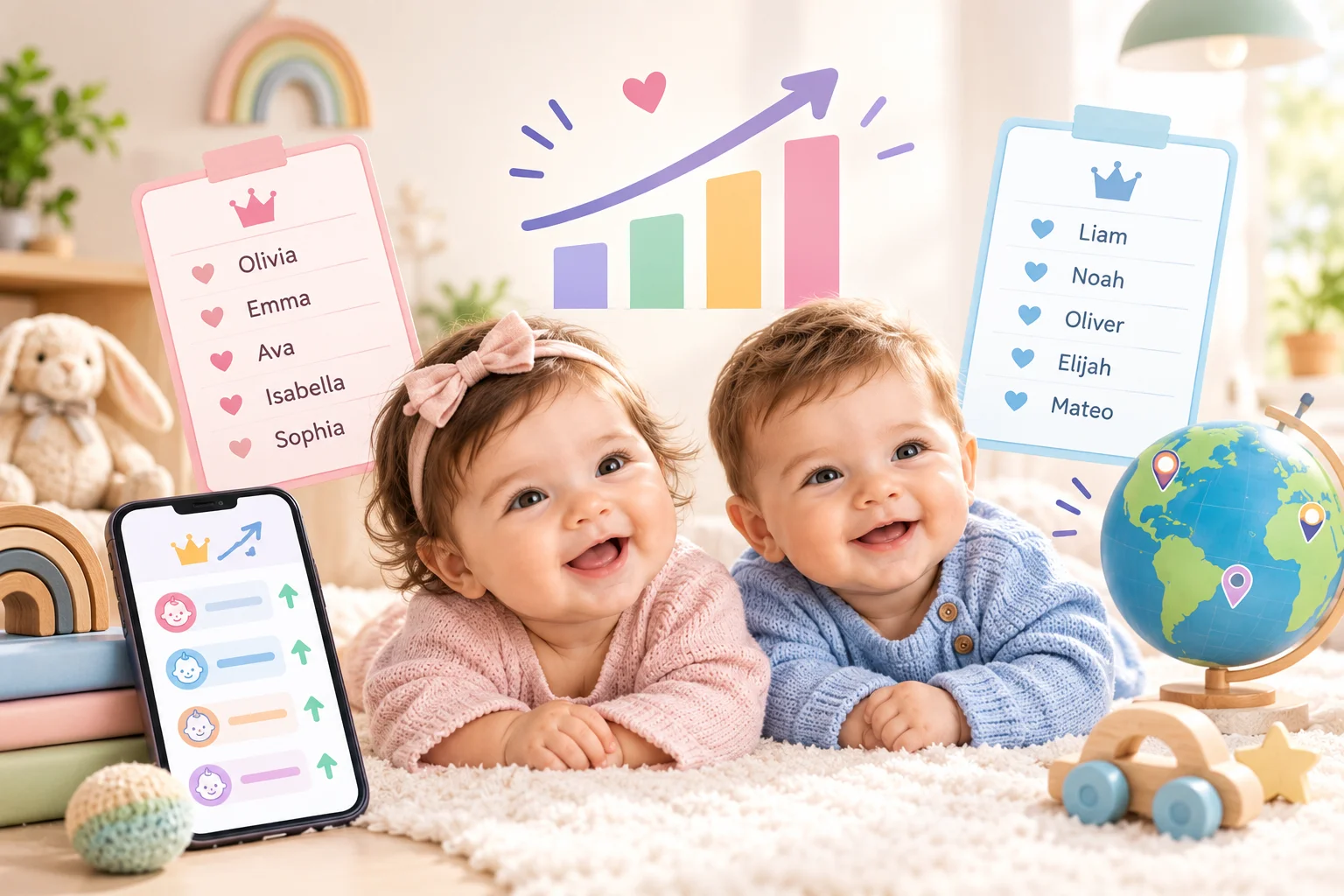
Baby name trends usually start from a visible cultural source — a celebrity, a TV show, a royal birth, a bestselling book, or a shift in social values — and then spread through everyday exposure: family, friends, media coverage, and now social media and baby name generator searches. As more parents hear and use a name, it feels familiar and safer to choose, which drives further popularity until public taste eventually shifts again.
Every year, certain baby names suddenly seem to be everywhere — in classrooms, in family group chats, and on the newborn lists friends share. Parents searching a baby name generator often notice the same handful of names appearing again and again, while others that were once common quietly fade. This raises a natural question: how do baby name trends actually start, and what makes them spread from one family to the next, and from one country to another?
Understanding this pattern can help parents make a more informed choice, whether they want something classic and enduring or a name that feels genuinely unique. This article looks at where naming trends come from, how they travel, and what today's parents can take from that pattern when using an AI baby name generator or exploring baby name meanings.
What Shapes a Baby Name Trend?
A baby name trend is simply a name, or a naming style, that a noticeably larger number of parents choose within a certain period of time. Several factors influence whether a name catches on:
• Familiarity names feel safer to choose once parents have heard them used positively elsewhere.
• Sound and spelling short, easy-to-pronounce names tend to travel further than complex or hard-to-spell ones.
• Meaning parents are often drawn to names with a meaning that feels personal, hopeful, or significant.
• Cultural identity some trends reflect a desire to honor heritage, family history, or tradition.
• A balance of uniqueness and acceptance many parents want a name that stands out without being difficult for teachers, friends, or future employers to say or spell.
These factors do not act alone. A name usually needs several of them working together — for example, a pleasant sound plus a meaningful origin plus public visibility — before it becomes a recognizable trend.
How Do Baby Name Trends Actually Start?
Naming trends rarely appear out of nowhere. They tend to start at an identifiable point and then ripple outward. Below are the most common starting points.
Celebrities and Public Figures
When a well-known public figure has a child, or when a celebrity's own name becomes widely recognized, their name is suddenly heard by millions of people. This exposure alone does not guarantee a trend, but it introduces the name to parents who may not have considered it before.
Television, Film, and Literature
Popular shows, movies, and books regularly introduce names to a wide audience. A well-loved character can make an uncommon name feel warm and familiar simply through repeated, positive exposure over the course of a series or story.
Royal and Historical Names
Royal births and historical figures have long influenced baby naming. Traditional or formal names connected to royalty or history often see renewed interest after a widely covered public event, as parents associate the name with dignity or timelessness.
Cultural and Family Revival
Some trends are not new at all — they are the return of names that were common a generation or two ago. Parents often revisit their grandparents' or great-grandparents' names, giving older names a fresh wave of popularity as they start to feel nostalgic rather than dated.
Shifts in Language and Sound Preferences
Broader taste in language also shapes trends. For example, many parents have gravitated toward short, vowel-ending names or nature-based words as a style, independent of any single celebrity or show. This kind of trend spreads more gradually, through general cultural taste rather than one specific event.
How Do Baby Name Trends Spread From One Region to Another?
Once a name gains attention in one place, several channels help it travel further:
1. Media and entertainment — international television, streaming, and news coverage expose names to audiences far beyond their place of origin.
2. Migration and cultural exchange — as families move between countries and communities, they bring naming traditions with them, introducing new names to new regions.
3. Social media — platforms where parents share name lists, reactions, and baby announcements accelerate exposure and can popularize a name in a matter of months.
4. Online name research — many parents now compare options using a baby name generator or name-meaning pages before deciding, which means popular tools and reference sites both reflect and reinforce which names are being searched most.
This combination of media reach and everyday online research means that today's baby name trends often spread faster and more widely than they did a generation ago.
What Role Does an AI Baby Name Generator Play in Today's Naming Trends?
An AI baby name generator is a tool that suggests name ideas based on the preferences a parent enters, such as style, origin, meaning, sound, or gender. Rather than scrolling through long alphabetical lists, parents can narrow down options that actually match what they are looking for.
These tools do not create trends on their own. Instead, they make it easier for parents to discover names that are already gaining attention, as well as unique baby names that might otherwise be overlooked. Because an AI baby name generator can surface a wide range of options quickly, it often helps parents compare a popular, trending name against a lesser-known alternative side by side — which can make it easier to choose a name that feels distinctive rather than simply following the crowd.
Are Gender-Neutral Baby Names Becoming More Popular?
Yes — gender-neutral names have become a noticeably more common naming style in recent years. Gender neutral names, sometimes called unisex baby names, are names that are used for children regardless of gender. Examples often cited in naming discussions include names like Rowan, Avery, and Kai.
Parents may choose a gender-neutral name for several reasons: they like the sound or meaning independent of gender associations, they want a name with long-term flexibility, or they simply find the style modern and appealing. As with any naming decision, it is worth considering how the name pairs with a family surname and how it may be perceived in different settings.
What Other Naming Styles Are Trending?
Beyond gender-neutral names, a few thematic naming styles have grown in popularity as parents look for names with a sense of story, symbolism, or personal meaning.
|
Naming Method |
What It Considers |
Best For |
|
Zodiac-based naming |
The baby's astrological sign and traditional meanings or symbols associated with it |
Parents who enjoy astrology as a personal or cultural interest |
|
Celestial naming |
Stars, moons, planets, and sky-related imagery |
Parents who want a name with a sense of wonder or cosmic meaning |
|
Mythological naming |
Figures, gods, or symbols from a specific mythology or cultural tradition |
Parents drawn to strong, storied names with deep roots |
|
Gender-neutral naming |
Names that work well regardless of gender, often nature- or word-based |
Families who want flexibility or a modern, unisex feel |
|
AI-assisted discovery |
Combines chosen filters (style, origin, sound, meaning) to surface options quickly |
Parents who want a faster, more organized way to explore many names |
Zodiac names draw on the baby's astrological sign or associated symbolism. This is a cultural and personal naming approach rather than a scientifically proven method, and families who enjoy astrology may find it a meaningful way to connect a name to their child's birth.
Celestial baby names — inspired by the moon, stars, and sky — have also grown in popularity, likely because they combine a sense of wonder with names that are often short and easy to say, such as Luna or Stella.
Mythological baby names draw from the gods, heroes, and figures of traditions such as Greek, Norse, or Roman mythology. These names often carry strong, memorable meanings, though it is worth remembering that mythological stories are cultural and legendary material rather than historical fact.
A Few Example Names and Their Meanings
Name meanings can help illustrate how different naming styles come together. A few examples, drawn from commonly referenced origins:
|
Name |
Meaning |
Origin |
Style / Category |
|
Olivia |
Commonly linked to the Latin word for "olive tree," a symbol of peace |
Latin (popularized in English through literature) |
Classic, widely popular |
|
Luna |
"Moon" in Latin and Italian |
Latin/Roman |
Celestial, nature-inspired |
|
Kai |
Meaning varies by culture; associated with "sea" in Hawaiian and used across several other languages with different meanings |
Multiple origins (Hawaiian, Scandinavian, and others) |
Gender-neutral, short and modern |
|
Rowan |
Linked to the rowan tree in English usage; also an Irish surname meaning "little red one" |
Irish/Gaelic |
Gender-neutral, nature-inspired |
|
Atlas |
In Greek mythology, Atlas was a Titan said to hold up the sky |
Greek mythology |
Mythological, strong sound |
It is worth noting that many names have more than one accepted meaning, spelling, or origin story, particularly when a name has been used across multiple cultures or languages over time. When in doubt, it can help to look at a few different sources for a name's meaning before deciding.
How Long Do Baby Name Trends Usually Last?
Naming trends tend to move in cycles rather than lasting forever. A name connected to a specific celebrity or show may rise quickly and fade within a few years, while a broader style — such as nature-inspired or gender-neutral naming — can remain popular for a decade or longer. Historically, names that fall out of favor often return one or two generations later, once they start to feel nostalgic rather than old-fashioned.
This cyclical pattern is one reason many parents choose to balance trend awareness with personal meaning: a name chosen for family significance, rather than popularity alone, tends to feel right regardless of how naming trends shift over time.
Practical Tips for Choosing a Name — Trendy or Timeless
Whether a name is currently trending or more classic, a few practical steps can make the decision easier:
• Say the full name out loud, including the middle name and surname, to check the flow and rhythm.
• Check the initials to avoid unintended abbreviations.
• Research the name's meaning and origin, and note if it has more than one interpretation.
• Consider how the name might be shortened or nicknamed, and whether that fits your preference.
• Think about long-term use — how the name may suit a child, a teenager, and eventually an adult.
• If you like a trending name but want something less common, look for a similar-sounding or similarly-themed alternative.
• Involve family members thoughtfully, while remembering the final decision belongs to the parents.
Explore More With Jollynames.ai
Once you have a better sense of the naming style you love — whether that is a gender-neutral name, a celestial or mythological name, or something tied to your family's culture — Jollynames.ai can help you explore more possibilities. The platform's AI baby name generator lets parents filter ideas by style, origin, and meaning, while additional tools like zodiac name exploration and celebrity birthday matching add a fun, personal layer to the naming process.
Baby name trends start from recognizable cultural moments — a celebrity, a story, a historical figure, or a broader shift in taste — and then spread through media, migration, social sharing, and everyday online research. Understanding this pattern will not tell you exactly which name to choose, but it can help you recognize why certain baby names feel familiar and why others feel fresh and unique.
Whether you are drawn to a name currently trending or one your family has used for generations, the most meaningful baby names are usually the ones chosen with intention. Tools like a baby name generator can help you explore ideas more efficiently, but the final decision is always a personal one.
Frequently Asked Questions
What is a baby name generator?
A baby name generator is an online tool that suggests baby names based on preferences a parent enters, such as gender, origin, meaning, style, or sound. Instead of browsing long lists manually, parents can quickly narrow results down to names that genuinely match what they are looking for.
How does an AI baby name generator work?
An AI baby name generator processes the filters and preferences a parent selects — such as cultural origin, meaning, or naming style — and matches them against a database of names to suggest relevant options. It is a discovery tool meant to speed up research, not a system that guarantees any single "correct" name.
How do I choose a meaningful baby name?
A practical approach is to start with what matters most to your family, such as meaning, cultural background, or family tradition, then narrow your list using sound, spelling, and how the name pairs with your surname. Researching a name's origin and multiple possible meanings can also help confirm it feels right.
Why do some baby names suddenly become popular?
A name often becomes popular after gaining visibility through a celebrity, a television show or film, a royal event, or a broader cultural shift. Once enough parents hear and use the name, it becomes more familiar, which tends to encourage even wider use.
Do baby name trends differ by country?
Yes. While some names trend internationally due to global media, many naming trends remain specific to a country or region, shaped by local culture, language, and tradition. A name that is common in one country may be rare in another.
Are gender-neutral baby names a passing trend?
Gender-neutral names have grown steadily in popularity over recent years rather than appearing as a short-lived trend. Many parents choose them for their flexibility and modern feel, though as with any naming style, individual preference varies.
Can AI predict who my baby will look like?
AI-based baby look-alike tools can generate a fun, illustrative estimate based on uploaded photos, but they are entertainment-oriented and not a scientifically reliable prediction of a future child's actual appearance. A real child's features depend on complex genetic factors that no current tool can accurately forecast.
How can I find celebrities who share my baby's birthday?
Some baby-naming platforms, including Jollynames.ai, offer a feature that matches a baby's birth date with historical figures or celebrities born on the same day, based on publicly available birth date records. It is designed as a fun, shareable way to connect a birth date to well-known names, not a claim of any deeper connection.
Should I choose a trending name or a classic one?
Both approaches are valid. A trending name may feel modern and connect your child to their generation, while a classic name often ages well and carries long-standing meaning. Many parents find a middle ground by choosing a classic name with a modern spelling, or a trending name with strong personal significance.
Where can I get name suggestions based on meaning or style?
An AI baby name generator, such as the one available on Jollynames.ai, allows parents to filter names by style, origin, and meaning. This can be a helpful starting point for narrowing down unique baby names or exploring options like zodiac names, celestial baby names, or mythological baby names.