Finding Baby Names That Work Across Different Cultures
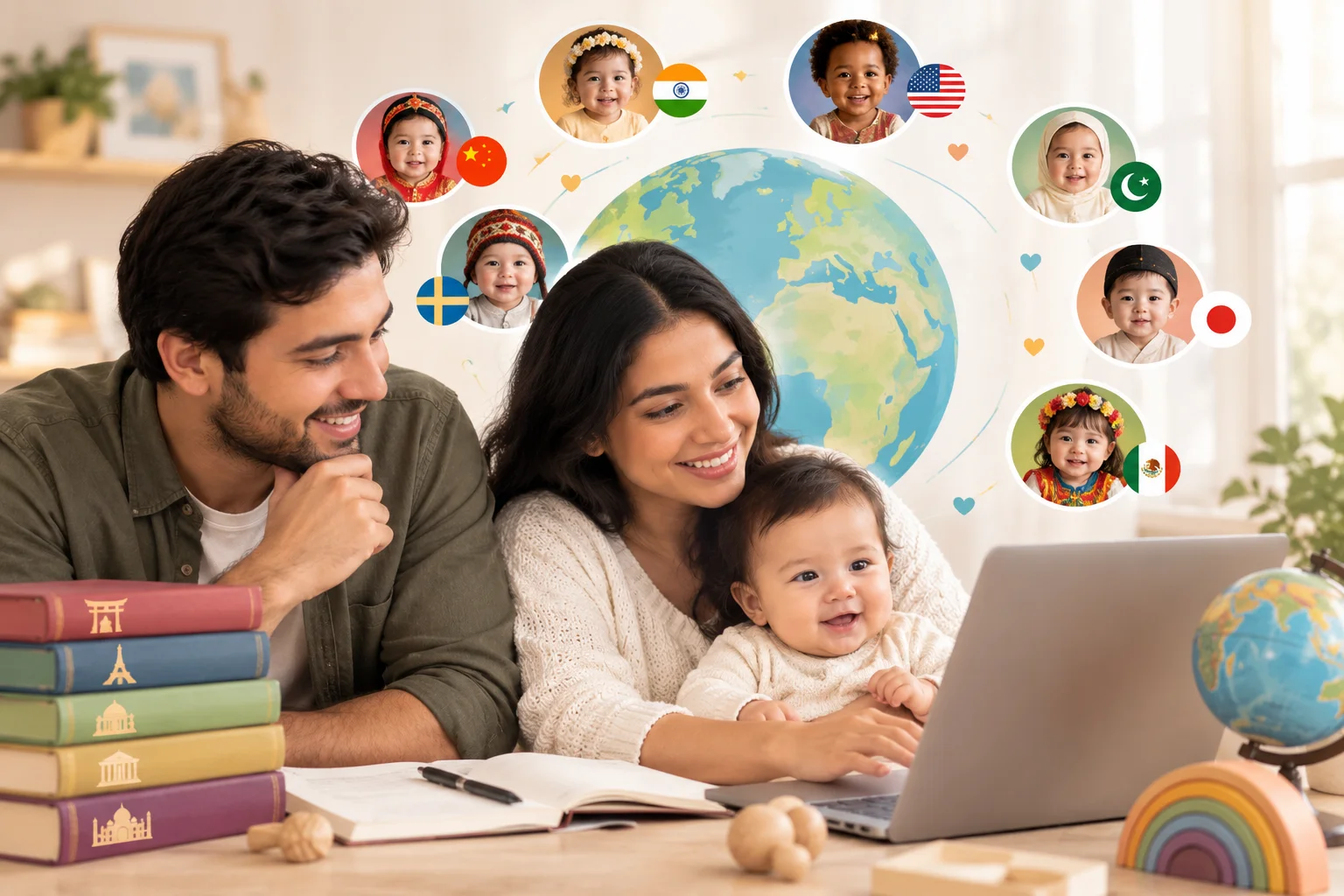
To find a baby name that works across cultures, shortlist names you both like, then check how each is pronounced, spelled, and understood in every language your family uses. Verify the meaning and any unintended associations, learn the relevant naming traditions and legal rules, and test the name with relatives. A meaning-based name generator can help you discover names that share a theme across languages.
One grandparent cannot pronounce the name you love. A name your partner’s family suggested sounds different in yours. A favorite from one language means something unexpected in another. Choosing a name for a family that spans cultures, languages, or countries adds layers most naming guides skip. This article explains what makes a name work across cultures, how to check pronunciation, spelling, meaning, and tradition, and how to find common ground between families. You will also see how a baby name generator by meaning can help you discover names that carry a similar idea in several languages.
What Makes a Baby Name Work Across Cultures?
A cross-cultural name is one that people can pronounce, spell, and respect in each language and community your child will live in. No name works perfectly everywhere, so the goal is a good fit for the places that matter to your family.
Four qualities help:
• Pronounceable. Speakers of each language can say it reasonably close to how you intend.
• Recognizable in writing. The spelling is stable, or its variants are ones you accept.
• Free of unwelcome meanings. It does not mean something unfortunate in a language your child will encounter.
• Respectful of tradition. It honors the naming customs that matter to each side of the family.
These qualities do not mean you must avoid a heritage name that is harder to pronounce elsewhere. Many families choose a distinctive name for its meaning or history and teach others how to say it. The list simply helps you make that choice knowingly.
Why Is Choosing a Name Harder for a Multicultural Family?
It is harder because a name has to meet several sets of expectations at once: different sounds, spellings, meanings, traditions, and sometimes legal rules. A name that is easy in one language can be confusing or unexpected in another.
Common sources of trouble include:
• Sounds that shift between languages. Jonas is pronounced roughly YOH-nas in German but JOH-nus in English. Hugo has a silent H in French and Spanish but a pronounced one in English and German. In Spanish, the J in Javier sounds like an English H.
• Spelling variants. Layla, Leila, and Laila are all used for the same Arabic name, and Arabic names are transliterated in many ways.
• Unintended meanings. Gift is a given name in some places, but in German the word means “poison.”
• Different gender associations. Andrea is usually a man’s name in Italy but a woman’s name in many other countries.
• Competing traditions. Each side of the family may expect different naming customs.
These are examples, not a complete list, so each finalist deserves its own check.
How Do You Choose a Baby Name That Works in Multiple Languages?
List the languages and communities your child will encounter, rank your priorities, build a combined list, and check each name for pronunciation, spelling, meaning, tradition, and legal rules. Then test your finalists with relatives who speak each language.
1. List your languages and communities. Include home, extended family, school, and the country where you live.
2. Rank your priorities. Decide what matters most: heritage, ease of pronunciation, a shared meaning, or honoring a relative.
3. Build a combined list. Include names from each side of the family and a few that cross both.
4. Check pronunciation. Ask native speakers to say each name, or listen to recordings from a trusted source.
5. Check spelling and scripts. Find out how the name is written in each language and whether it has common variants.
6. Check meaning and associations. Look the name up in each language and ask speakers what it brings to mind.
7. Check traditions and rules. Learn the customs and legal requirements involved.
8. Test with relatives. Say the name in ordinary conversation and listen for hesitation.
Examples of Bridge Names
A bridge name is one that is used, in some form, across several languages or communities. The table gives examples. Origins can be debated, and pronunciation varies by language, so verify each in a reliable reference.
|
Name |
Origin and meaning |
Notes across languages |
|
Anna |
Form of the Hebrew Hannah, often explained as “grace” or “favor” |
Used widely across Europe, with similar spelling |
|
Sofia |
Greek sophia, “wisdom” |
Spelled Sofia or Sophia; pronunciation varies |
|
Leo |
Latin, “lion” |
Used in many European languages |
|
Noah |
Hebrew, often explained as “rest” or “comfort” |
Connected to the Arabic form Nuh |
|
Adam |
Hebrew, linked to the word for “earth” or “ground” |
Used in Hebrew, Arabic, and European languages |
|
Sara or Sarah |
Hebrew, “princess” |
Used in Arabic and European languages, with spelling variants |
|
Lina |
Arabic, often explained as “tender”; also a short form of names such as Carolina |
Several origins, so confirm which one fits your family |
|
Maya |
Several origins, including Sanskrit māyā (often explained as “illusion”), and the Greek Maia |
Multiple interpretations, so choose the one you connect with |
Many of these names have more than one accepted origin. That is not a problem, but it is worth knowing which story you will tell.
How Can a Baby Name Generator by Meaning Help Multicultural Families?
A baby name generator by meaning suggests names based on what they signify, which is helpful when partners come from different languages but share a value they want a name to carry. It lets you start from an idea, such as light or hope, rather than from one language’s list.
A Meaning-Based Example
Suppose a couple wants a name that means hope. Searching by meaning, they might find:
• Esperanza: Spanish, “hope.”
• Elpida: Greek, “hope.”
• Tikva: Hebrew, “hope.”
• Nadezhda: Russian, “hope.”
If light is the theme, they could explore Noor (Arabic), Svetlana (Slavic, from a root meaning “light”), Phoebe (Greek, “bright”), or Uri (Hebrew, “my light”). Each idea appears across languages, so the family can choose the language that fits best.
A few tips for using a generator:
• Start with a shared value, not a language.
• Verify each meaning in a reliable reference, since a tool’s suggestion is a lead and not a final fact.
• Ask native speakers to say the name before you fall in love with it.
Jollynames.ai offers an AI baby name generator for exploring names by meaning, theme, and tradition. Use it for discovery, then apply the checks above.
How Do You Narrow Down a Cross-Cultural List?
Have each partner choose five names, add a few names that share a meaning, then score each name for pronunciation, meaning, and tradition in every language you use. Keep the top three for a closer comparison.
A Shortlisting Exercise
1. Each partner lists five names from their own background.
2. Add five shared-meaning names found through a generator or reference.
3. Remove strong vetoes. Each person crosses off names they dislike.
4. Score the rest from 1 to 5 for pronunciation in each language, meaning, and tradition.
5. Keep three finalists.
A Sample Comparison
The table compares three hypothetical finalists for a family that uses English and Arabic. The details are invented for illustration.
|
Criteria |
Lina |
Leo |
Sofia |
|
Meaning and origin |
Arabic, often “tender”; also a short form elsewhere |
Latin, “lion” |
Greek, “wisdom” |
|
English pronunciation |
Easy |
Easy |
Easy |
|
Arabic pronunciation |
Easy |
Easy |
Easy |
|
Spelling variants |
Few |
Few |
Sofia or Sophia |
|
Family significance |
Honors a great-aunt |
None |
None |
|
Parents’ gut feeling |
Strong favorite |
Warm |
Pleasant |
In this example, Lina has the strongest family tie and the fewest practical issues, so the parents would examine its meaning and origin more closely.
How Do You Respect Naming Traditions From Different Cultures?
Learn what each tradition expects, ask elders how flexible it is, and find ways to honor each one, such as using the first name for one tradition and the middle name for another. Practices vary widely within every culture, so ask your own family.
Examples of traditions include:
• Spanish-speaking families often give children two surnames, one from each parent.
• Akan communities in Ghana commonly give day names based on the day of birth, such as Kofi for a boy born on Friday or Ama for a girl born on Saturday.
• Some Jewish communities, particularly Ashkenazi ones, traditionally name children after deceased relatives rather than living ones.
• Many Hindu families hold a naming ceremony, often called namakarana.
• Some Chinese families use a shared generation character in given names.
• Icelandic naming often uses patronymics rather than family surnames.
If traditions conflict, you can honor both. One name might come from one culture and another from the other, or a heritage name can serve as a middle name.
What If Families or Partners Disagree?
Separate what each tradition requires from what it merely prefers, then look for a compromise that honors the requirements. Disagreements often shrink when each side explains the reason behind a preference.
• Ask why. A grandparent may want a name to honor a relative, which could be satisfied in the middle position.
• Rank must-haves and nice-to-haves. Trade a nice-to-have on one side for a must-have on the other.
• Use a veto-and-champion system. Each parent gets a few vetoes and a few champion names the other considers fairly.
• Avoid framing it as one culture winning. Aim for a name both families can say with pride.
• Set a deadline so the discussion moves forward.
What Legal and Practical Rules Should You Check?
Check the naming laws and document rules of every country that will issue your child’s documents. Rules differ, they change, and they can limit which names or characters are allowed, so confirm with an official source.
Examples include:
• Approved-name systems. Denmark and Iceland have processes for approving names that are not already accepted.
• Registry discretion. In Germany, registry offices can refuse names they consider harmful to a child.
• Character rules. In Japan, registered names must use approved characters.
• Accents and special characters. The machine-readable zone of a passport uses basic Latin letters, so accents may be changed or dropped there. If your child will hold more than one passport, check that the spelling is consistent across documents.
Ask the relevant registry office or embassy for current requirements before you finalize the name.
What Should You Check Before Finalizing a Baby Name?
Before finalizing, confirm that the name passes the cross-cultural checks as well as the usual practical ones. Use this checklist.
Baby Name Decision Checklist
• ☐ Pronunciation checked with speakers of each language.
• ☐ Spelling and common variants understood, including in other scripts.
• ☐ Meaning and origin confirmed in at least two reliable sources.
• ☐ Unintended meanings checked in languages your child will encounter.
• ☐ Gender associations checked across cultures.
• ☐ Traditions from each side respected where possible.
• ☐ Legal rules confirmed for each country involved.
• ☐ Accents and characters work on official documents.
• ☐ Initials and surname flow are natural.
• ☐ Gut feeling is positive after a few days of use.
Frequently Asked Questions
Can I give my baby one name for each culture?
Many families do, using a legal name plus a heritage name or a middle name from the other tradition. Whether this is allowed depends on local registration rules, so check with the registry office. Consistency across documents is also worth confirming if your child will hold more than one passport.
How do I check that a name does not mean something unwelcome in another language?
Look it up in a name reference and a dictionary for each language, and ask native speakers what it brings to mind. Also search the name online. These steps reduce the risk but cannot guarantee that no one will find an unintended association.
What if the name I love is hard to pronounce in my partner’s language?
Some families accept an adapted pronunciation, some teach relatives the original, and some choose a different name. Ask speakers how close they can get, and decide how much variation you are comfortable with before you commit.
Can a baby name generator by meaning help with multicultural names?
It can help you find names that share a meaning across languages, which gives partners from different backgrounds common ground. Verify each meaning in a reliable reference and ask native speakers to say the name before you decide.
Should the first name or the middle name carry the heritage?
There is no rule. Some families give the heritage name first, others use it as a middle name, and some use both traditions in two names. Choose the arrangement that suits your family and works with the documents you will need.
How do I handle accents or special characters in my baby’s name?
Check whether official forms, passports, and databases in each country accept them. Systems often convert accented letters to basic ones, so decide in advance whether your family is comfortable with that and keep the spelling consistent across documents.
A name that works across cultures is not one that is identical everywhere. It is one that your family can say, write, and explain with confidence in the places that matter. Start with a shared value, check pronunciation, spelling, meaning, and tradition in each language, and confirm any legal requirements before you commit. Where traditions differ, look for ways to honor each one, such as a middle name or a shared meaning. This is a personal family decision, and the best name is one that connects your child to the people who love them.
Looking for names that carry the same idea across languages? Explore meaningful baby name ideas with Jollynames.ai and find options that feel right for your family.