How to Tell If Your Baby Name Is Too Unique
A baby name may be too unique if it's difficult for most people to spell or pronounce on first try, has no clear meaning or origin, doesn't pair well with your surname, or is likely to require frequent explanation throughout your child's life. None of these signs are automatic dealbreakers, but together they're worth weighing carefully.
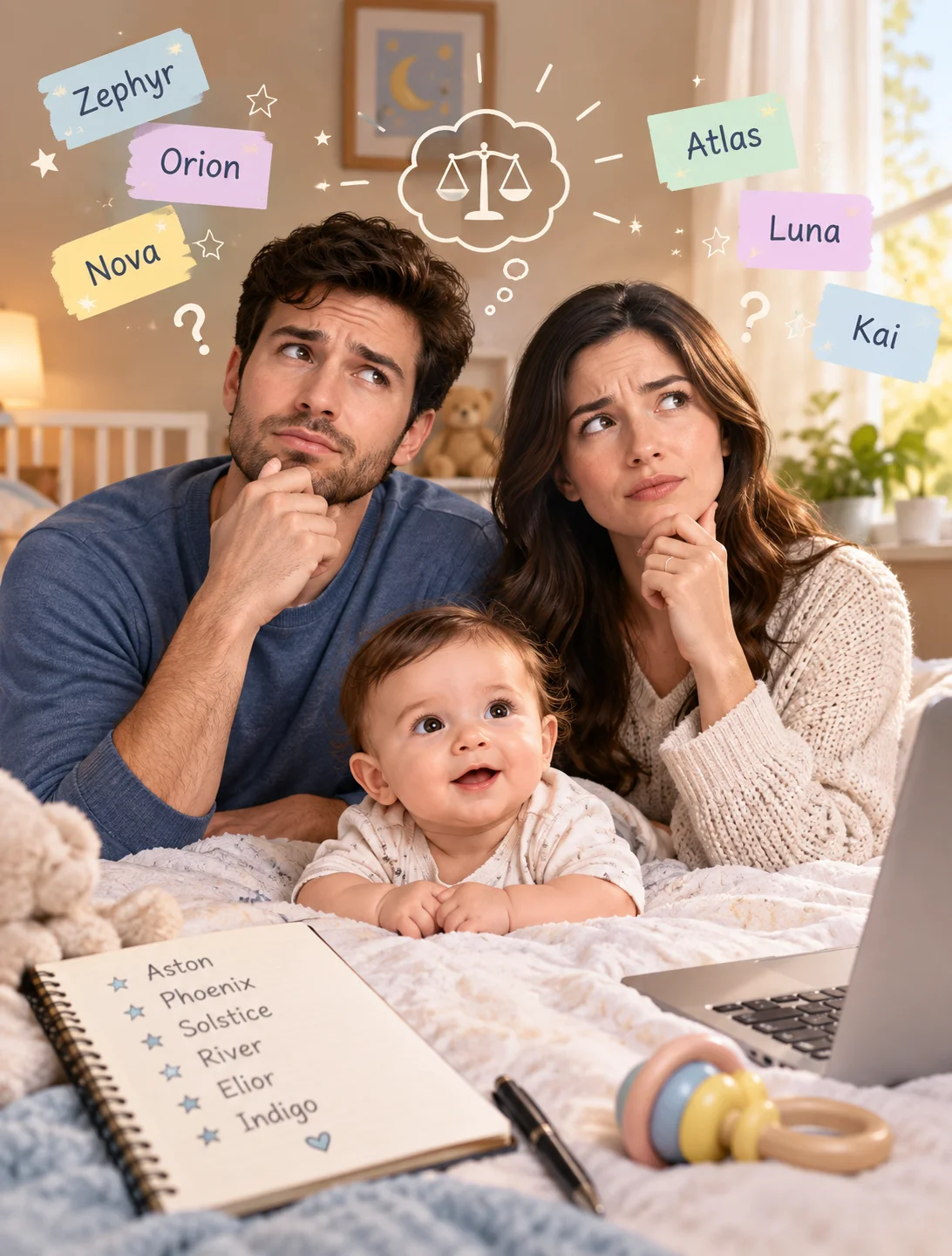
Choosing a name that stands out is exciting, but many parents pause partway through the search and ask a quieter question: could this baby name be too unique? Between wanting your child to have a name that feels special and worrying it might be confusing, hard to say, or difficult to grow up with, it's a genuinely tricky balance to strike.
This article walks through the practical signs that a baby name may be veering from "wonderfully unique" into "hard to live with," along with simple ways to test a name before you commit. You'll also see how the idea of unique baby names differs from names that are simply rare, and how a baby name generator can help you find something distinctive without the common pitfalls.
What Does "Too Unique" Mean for a Baby Name?
"Too unique" isn't an official naming term — it describes a point where a name's distinctiveness starts to create everyday friction rather than simply standing out. A unique baby name and a name that's "too unique" aren't automatically the same thing; the difference usually comes down to how workable the name is in daily life, not how rare it is.
Many wonderfully unique names are easy to say, spell, and understand once you hear them. Others may be distinctive to the point that your child will spend years correcting pronunciation or explaining the name's origin — which isn't wrong, but is worth knowing in advance.
What Are the Practical Signs a Name Might Be Too Unique?
A few concrete signals can help you judge where a name falls:
- Most people can't guess the pronunciation from the spelling, even after seeing it written.
- The spelling has been altered so heavily that it no longer resembles the original name it's based on.
- The name has no clear origin, language, or documented meaning behind it.
- It doesn't flow naturally with your family surname when said aloud.
- Friends or family members consistently mispronounce or misspell it after hearing it more than once.
- The name could realistically invite teasing due to an unintended meaning or sound in common usage.
One or two of these signs alone may not be a problem — plenty of well-loved names are occasionally mispronounced. It's the combination of several signs together that's usually worth pausing on.
Is There a Real Downside to a Very Unique Baby Name?
A practical approach is to think of uniqueness less as "good" or "bad" and more as a trade-off. A highly unique name can help a child feel distinctive and stand out, but it may also mean more frequent spelling corrections, pronunciation questions, or, in some cases, unwanted attention.
Parents may want to consider how often the name will need to be said, written, and explained across a child's life — on school forms, name tags, job applications, and everyday introductions. This doesn't mean a unique name is the wrong choice; it simply means it's worth going in with clear expectations about what that uniqueness will involve day to day.
How Is "Unique" Different From "Unusual" or "Invented"?
These three terms often get used interchangeably, but they describe different things. A unique baby name typically has a genuine origin and meaning, just used less frequently than more common names. A rare or unusual name may simply be old-fashioned or specific to a particular region or culture. A fully invented name has no prior linguistic history — it's created from scratch, often by combining sounds or altering spelling.
|
|
Unique Name |
Rare / Unusual Name |
Fully Invented Name |
|
Where it comes from |
Has a real origin, language, or cultural background, just used less often |
Genuinely uncommon, may be old-fashioned or region-specific |
Created without ties to any existing language or naming tradition |
|
Pronunciation |
Usually has one commonly understood pronunciation |
May need occasional clarification |
Often unclear, since there's no established pattern to reference |
|
Meaning |
Typically has a documented meaning or etymology |
May have a meaning, sometimes debated or regional |
Meaning is usually assigned by the parent rather than existing prior |
|
Example approach |
A less-common name from an existing culture or language |
A name that was common a century ago but rare today |
A newly combined or stylized spelling with no prior use |
None of these categories is inherently better than another — but understanding which one a name falls into can help you anticipate how it will be received and used by others.
How Can I Test Whether a Name Is Too Unique for My Family?
A few simple, low-effort tests can reveal a lot before you commit to a name:
1. Say the full name — first, middle, and last — out loud to a few people who haven't seen it written, and see how closely their guess matches the intended pronunciation.
2. Text or email the name to a friend without extra context, and ask them to read it back to you.
3. Write out the name in block letters and imagine it on a name tag, school folder, or job application.
4. Research the name's origin and meaning to confirm it has a documented background, and note if there are multiple accepted interpretations.
5. Consider likely nicknames, and decide whether you're comfortable with how the name might be shortened.
6. Ask a couple of trusted people for honest first impressions, while remembering the final decision is yours.
Can a Meaningful Naming Style Help Ground a Unique Name?
If you're drawn to something distinctive but want it to feel less "invented," choosing a unique name from within an established naming style can help. These styles offer built-in meaning and context, which often makes a name easier for others to understand and accept, even if it's still uncommon.
Gender-Neutral Names
Gender neutral names such as Rowan, Wren, or Emerson often carry real linguistic roots (nature words, surnames, or place names) even when they're used less frequently, which can make them feel unique without feeling unfamiliar.
Celestial Names
Celestial baby names — inspired by the moon, stars, and sky, like Luna, Orion, or Celeste — tend to have clear, easily understood meanings, which can soften the unfamiliarity of a less common name.
Mythological Names
Mythological baby names, such as Atlas, Freya, or Juno, draw on long-established stories and traditions. Because these names have existed for centuries within their originating mythology, they often feel grounded even when they're statistically uncommon today.
Zodiac names, tied to a baby's astrological sign or its symbolism, can also offer a meaningful, less mainstream option. It's worth remembering that zodiac-based naming is a personal or cultural approach rather than a scientifically proven method, so it works best for families who already connect with astrology as a source of meaning rather than fact.
How Does an AI Baby Name Generator Help Balance Unique and Practical?
An AI baby name generator is a tool that suggests baby names based on preferences you enter, such as style, origin, meaning, or sound. One useful way to narrow the list is to filter specifically for names that are uncommon but still have a documented origin, rather than searching broadly for "unique" results that might include invented spellings.
This kind of filtering can help you land on unique baby names that still meet practical checkpoints — clear pronunciation, a real meaning, and a workable pairing with your surname — without spending hours manually researching each option.
Practical Tips for Choosing a Name That's Unique But Still Workable
• Favor names with one commonly accepted pronunciation over multiple possible readings.
• If you love an unusual spelling, test it against the standard spelling to see if the difference is worth the extra explanation it may require.
• Choose a name with a documented meaning or origin, even if the name itself is uncommon.
• Check that the name works well with common nicknames or shortened versions, in case others use them.
• Say the name with your surname out loud, more than once, to check the overall flow.
• If you're torn, consider placing the more unique option as a middle name and a simpler name first.
Explore More With Jollynames.ai
Once you have a sense of how unique you want your baby's name to feel, Jollynames.ai can help you explore more possibilities. The platform's AI baby name generator lets you filter by style, origin, and meaning, making it easier to find unique baby names that are distinctive without straying into confusing or hard-to-use territory.
Jollynames.ai also offers a few lighter, entertainment-focused features alongside its naming tools. Parents curious about their baby's future appearance can try the AI baby look-alike feature, which provides a fun, illustrative estimate rather than a scientifically accurate prediction, since a child's real appearance depends on complex and unpredictable genetic factors. There's also a feature to find celebrities who share your baby's birthday, matching your child's birth date with well-known figures born on the same day, purely as a fun and shareable detail.
A baby name becomes "too unique" less because of how rare it is, and more because of how much everyday friction it creates around spelling, pronunciation, or meaning. A name can be wonderfully distinctive and still be easy to say, spell, and explain — the two qualities aren't opposites.
Testing a name out loud, researching its background, and getting a few honest outside impressions can go a long way toward finding that balance. A baby name generator can help you explore unique baby names that check both boxes — distinctive and workable — so you can choose a name you feel confident about long after the newborn stage.
Frequently Asked Questions
What is a baby name generator?
A baby name generator is an online tool that suggests baby names based on preferences you enter, such as style, origin, meaning, or gender. It helps you explore a large pool of names more efficiently than browsing manually.
How does an AI baby name generator work?
An AI baby name generator matches your selected filters and preferences against a database of names to suggest relevant options. It's designed to speed up discovery, not to guarantee a single "correct" choice for your family.
What makes a baby name unique?
A baby name is generally considered unique when it's used less frequently than common names but still has a documented origin, language, or meaning. Uniqueness is a matter of degree — some names are mildly uncommon, while others are extremely rare.
Is a unique baby name the same as an invented one?
Not necessarily. A unique name often has real linguistic roots and an established meaning, just used less often. An invented name is created without ties to any existing language or naming tradition, which can make its origin and pronunciation less predictable.
Will an unusual baby name cause problems later in life?
This varies by name and by individual experience. Some people with unusual names report frequent spelling or pronunciation corrections, while others find their distinctive name to be a positive, memorable part of their identity. Testing the name's pronunciation and meaning in advance can help you anticipate which experience is more likely.
How can I test if a name is too hard to pronounce?
A simple test is to text or email the written name to a few people without extra context and ask them to read it back to you. If most guesses are close to the intended pronunciation, the name is likely easy enough for everyday use.
Are gender-neutral baby names a good option for a unique but workable name?
Many gender-neutral names, such as Rowan or Wren, combine distinctiveness with clear, real-word origins, which can make them easier to understand than fully invented names while still standing out from more common choices.
Is zodiac-based baby naming considered too unique?
Zodiac names, based on a baby's astrological sign or its symbolism, can be less common choices, but they typically draw on well-established astrological or cultural references, which gives them a recognizable meaning even when the name itself is rare.
Can AI predict who my baby will look like?
AI-based baby look-alike tools can generate a fun, illustrative estimate from uploaded photos, but this is an entertainment feature, not a scientifically reliable prediction. A child's actual appearance depends on complex genetic combinations that no current tool can accurately forecast.
How can I find celebrities who share my baby's birthday?
Some baby-naming platforms, including Jollynames.ai, offer a feature that matches your baby's birth date with historical figures or celebrities born on the same day, based on publicly available birth date records. It's meant as a fun, shareable detail rather than a claim of any deeper significance.