
What Do You Wear to a Baby Naming Ceremony?
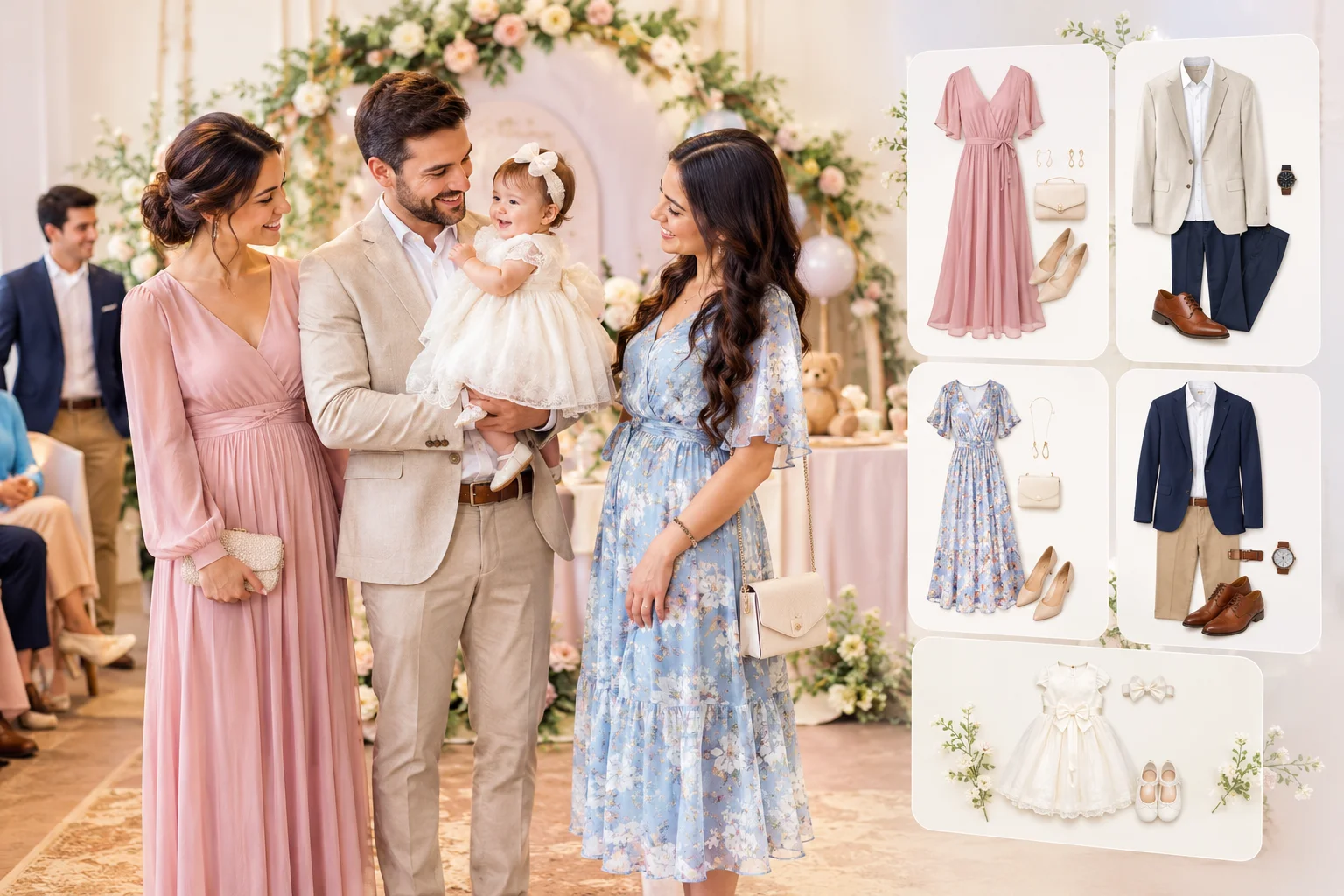
For a baby naming ceremony, most guests wear smart casual or semi-formal clothing in soft, comfortable fabrics: a dress, skirt or tailored trousers with a blouse for women, and a collared shirt with chinos or a suit for men. Choose light or pastel colours, check the invitation for a dress code or tradition, and avoid anything revealing or attention-grabbing.
You have the invitation and the date is set, and now comes the question almost every guest and parent asks: what do you wear to a baby naming ceremony? Unlike a wedding, a naming ceremony has no single rulebook. The dress code depends on the family, the venue, the time of day and the traditions being followed, which is why a pastel linen dress suits one ceremony and a formal saree or suit suits another. Getting it right matters because the day is meant to feel warm, respectful and joyful, and nobody wants to feel under- or overdressed beside the family.
This guide explains how to read the invitation, what guests, parents, grandparents and babies typically wear, how to dress for different settings and seasons, which colours and fabrics work best, and a simple checklist for choosing your outfit with confidence.
How to Decide What to Wear to a Naming Ceremony
Read four clues before you shop: the invitation, the venue, the time of day and the tradition behind the ceremony. Together they tell you almost everything.
|
Clue |
What to look for |
What it suggests |
|
Invitation wording |
A dress code line, a theme, a colour request or words such as "formal" or "casual" |
Follow it exactly. If it says nothing, go smart casual. |
|
Venue |
Home, garden, community hall, restaurant, place of worship |
Home and garden lean relaxed. Halls and restaurants lean semi-formal. A place of worship follows its own norms. |
|
Time of day |
Morning, lunch, afternoon, evening |
Daytime means lighter colours and fabrics. Evenings allow richer tones and dressier pieces. |
|
Tradition |
Cultural or religious customs named on the invite |
Traditional attire may be welcome or expected. Ask if unsure. |
If the invitation gives no dress code
Default to smart casual and aim to sit slightly above the middle of the room. A guest who is a little neater than the family is rarely a problem. A guest in beachwear or very casual clothing at a family ceremony often is.
How a naming ceremony differs from a christening for dress
A naming ceremony is usually more relaxed than a christening, which is a Christian baptism service often held in a church with more formal expectations. That said, families vary widely. A naming ceremony held in a place of worship or following a religious custom may ask for covered shoulders, covered heads, or removal of shoes. When the invitation mentions a faith or custom, check what is expected rather than guessing.
Remember the camera
Most families take group photographs, and a name revealing ceremony often has a staged moment when the name is announced. Choose clothes you will be happy to see in the album for years: soft solid colours or gentle prints, nothing glaringly bright, and nothing with large slogans or logos.
What Guests Wear: Outfit Ideas by Dress Code
Use the row that matches the invitation, then adjust for the weather and your own comfort.
|
Dress code |
Women |
Men |
Teens and children |
|
Casual (home or garden) |
A midi dress, a skirt with a neat top, or tailored trousers with a blouse |
A polo or casual shirt with chinos |
Neat jeans or shorts, a clean shirt or sundress |
|
Smart casual (most common) |
A knee-length or midi dress, a jumpsuit, or a skirt with a blouse |
A collared shirt with chinos, no tie needed |
Dress trousers or skirt, a collared shirt or pretty dress |
|
Semi-formal (hall or restaurant) |
A longer dress, a co-ord set, a saree or a tailored suit |
A jacket with a shirt and dress trousers, tie optional |
A smart dress, or shirt with waistcoat or blazer |
|
Formal or traditional |
A formal dress, saree, salwar kameez or other traditional attire |
A suit, or traditional attire such as a kurta, sherwani or other cultural dress |
Traditional attire or a formal version of smart dress |
Shoes and accessories
• Comfortable shoes. Many ceremonies involve standing, walking on grass or sitting on the floor. Flats, low block heels, loafers or dress sandals usually work best.
• Light jewellery. Avoid anything that jingles loudly or could catch on a baby's hands, such as dangly earrings, large necklaces or sharp brooches if you plan to hold the baby.
• A wrap or light jacket. Halls and gardens can turn cool, and a shawl also helps if a place of worship asks for covered shoulders.
• A small bag. A compact bag or clutch is easier than a large tote when you are carrying a gift and a card.
If you are giving a speech or reading
Wear something you can stand in comfortably and that does not need constant adjusting. Choose a top without a plunging neckline, and avoid long sleeves that tend to rustle against a microphone. Keep your outfit simple so the focus stays on the words you are sharing.
If you are bringing children
Choose clothes children can sit, crawl and run in without worry. Soft cotton, easy fastenings and shoes they can walk in are better than stiff formalwear. Pack a spare outfit, since food and cake are part of most naming days.
What Parents, Grandparents and the Baby Wear
Hosts dress one step above their guests, and everyone close to the baby should be able to hold, feed and photograph the baby comfortably.
|
Role |
Outfit guidance |
|
Parents |
Dress slightly smarter than guests. Coordinate colours without matching exactly, and choose fabrics that tolerate being held against a baby, such as soft cotton blends. Nursing parents may prefer tops or dresses with easy access. |
|
Grandparents |
Many choose traditional attire or a smart outfit. Colours that photograph well and a comfortable seating arrangement make the day easier. |
|
Godparents and supporters |
Wear smart or semi-formal clothes. If you are holding the baby at the naming moment, avoid sharp jewellery and heavy perfume. |
|
Siblings |
Coordinate with the parents' palette, but prioritise comfort so they stay happy through the ceremony. |
|
Officiant or celebrant |
A neat, simple outfit in a plain colour. If a tradition has a specific garment, wear it. |
Baby outfit ideas
The baby's outfit is the centrepiece of every photograph, and comfort comes first.
• A soft white or cream gown or romper. Cotton and muslin are gentle on skin and easy to wash. This is a traditional choice for many families.
• A pastel or soft-toned outfit. Pale blue, blush, sage, lemon and lavender are all popular and photograph beautifully.
• A family heirloom. A gown or blanket worn by earlier generations adds meaning, so check it is clean, safe and fits well on the day.
• A traditional or cultural outfit. Many families dress the baby in clothing tied to their heritage. Choose pieces that are soft, lightweight and free of rough embroidery against the skin.
• A keepsake touch. Some parents add an embroidered or personalised item, such as a bib or blanket with the baby's initials or name, for photographs.
Practical rules for a baby's naming day outfit
1. Choose soft, breathable fabric with no scratchy lace, tight elastic or stiff collars.
2. Pick an outfit that opens easily for nappy changes. Press studs and wide necklines beat long rows of buttons.
3. Try the outfit on a few days earlier so you can check the fit and comfort.
4. Dress the baby for the temperature of the room, not just the photographs, and carry a light blanket.
5. Pack at least two spare outfits and a muslin cloth.
6. Avoid small decorations such as loose beads, large bows or detachable pearls that could become a hazard if they come off.
What to Wear by Setting, Season and Climate
The same dress code looks different at a garden party and in a banquet hall. Adjust for where you will be standing, sitting and eating.
|
Setting |
What works |
What to avoid |
|
At home |
Comfortable smart casual, easy to sit on the floor in. Check whether shoes come off at the door and wear clean, presentable socks if so. |
Very tight clothing, fussy shoes |
|
Garden or park |
Flat sandals, block heels or wedges, light layers, a hat or sunglasses |
Stiletto heels that sink into grass, white clothes near mud |
|
Community hall or restaurant |
Semi-formal outfits, dressier fabrics, a light layer for air conditioning |
Overly casual beachwear |
|
Place of worship |
Modest outfits that cover shoulders and knees, and a scarf or head covering if the tradition asks for it |
Revealing or sleeveless tops, loud slogans |
|
Beach or destination |
Light linen or cotton, flat sandals, sun protection, easy-care fabrics |
Heavy fabrics, delicate heels |
Dressing for the weather
• Hot or humid weather. Choose cotton, linen or light blends in pale colours. Avoid synthetic fabrics that trap heat and show sweat. Carry tissues and a small fan if the venue is not cooled.
• Cold weather. Layer a cardigan, blazer or shawl over your outfit, and check where coats will go. Dress the baby in warm layers that can be added or removed easily.
• Rainy season. Pick quick-drying fabrics, closed or grippy shoes and a compact umbrella. Avoid long hems that will drag in puddles.
• Mixed or unpredictable weather. Dress in layers so that you can adapt between an air-conditioned hall and an outdoor courtyard.
Dressing for the time of day
Morning and lunchtime ceremonies suit lighter colours and simpler pieces. Late afternoon and evening ceremonies allow richer tones, dressier fabrics and more formal accessories. If the ceremony runs from morning into a long lunch, choose clothing you can wear comfortably for several hours.
Colours, Fabrics and Cultural Considerations
Colours that work
Soft, light and gentle colours are the safest choice at most naming ceremonies. Think pale blue, blush, sage, lavender, cream, soft yellow, dusty rose and warm neutrals. Jewel tones such as emerald or deep teal work well for evening or formal events.
Colours to think twice about
• Head-to-toe white or cream. These colours are common for the baby and sometimes for the parents. If you are unsure, wear a touch of colour so you do not blend into the family's chosen look.
• Very bright or neon shades. These tend to draw attention away from the baby.
• Black. It is acceptable in many places, but in some cultures it is linked with mourning. If the family follows such a tradition, choose another colour or add a lighter accent.
• Strong themes or slogans. Leave graphic prints and logo-heavy clothing at home.
Colours carry different meanings in different cultures, so there is no universal rule. White, red, gold, black and green may signal celebration in one family and mourning or caution in another. When the ceremony follows a particular tradition, the safest approach is a quick message to the host.
Fabrics that make the day easier
• Cotton, linen and cotton blends breathe well and are comfortable for long days.
• Soft crepe, chiffon and light silk look elegant and travel well, though they can show water marks.
• Wrinkle-resistant fabrics help if you are travelling to the ceremony.
• Scratchy, sequinned or heavily beaded clothes can irritate a baby's skin when you hold them, so keep these for another occasion or add a soft layer.
Respecting cultural and religious customs
Naming ceremonies are celebrated in many communities, and each has its own approach to clothing. Some ask guests to wear traditional attire, cover the head or shoulders, remove shoes, or avoid certain colours. Others have no rules at all.
• Ask rather than assume. A short message to the host is always welcome.
• Wear traditional dress only if it is welcome. If you are not part of the culture, accept an invitation to wear it, and wear it as the family does rather than as a costume.
• Follow the venue's rules. Places of worship often have guidance for visitors, such as covering shoulders or removing footwear.
• Be modest if unsure. Covered shoulders and knee-length or longer hems are respectful in almost every setting.