
Who Can Officiate a Baby Naming Ceremony?
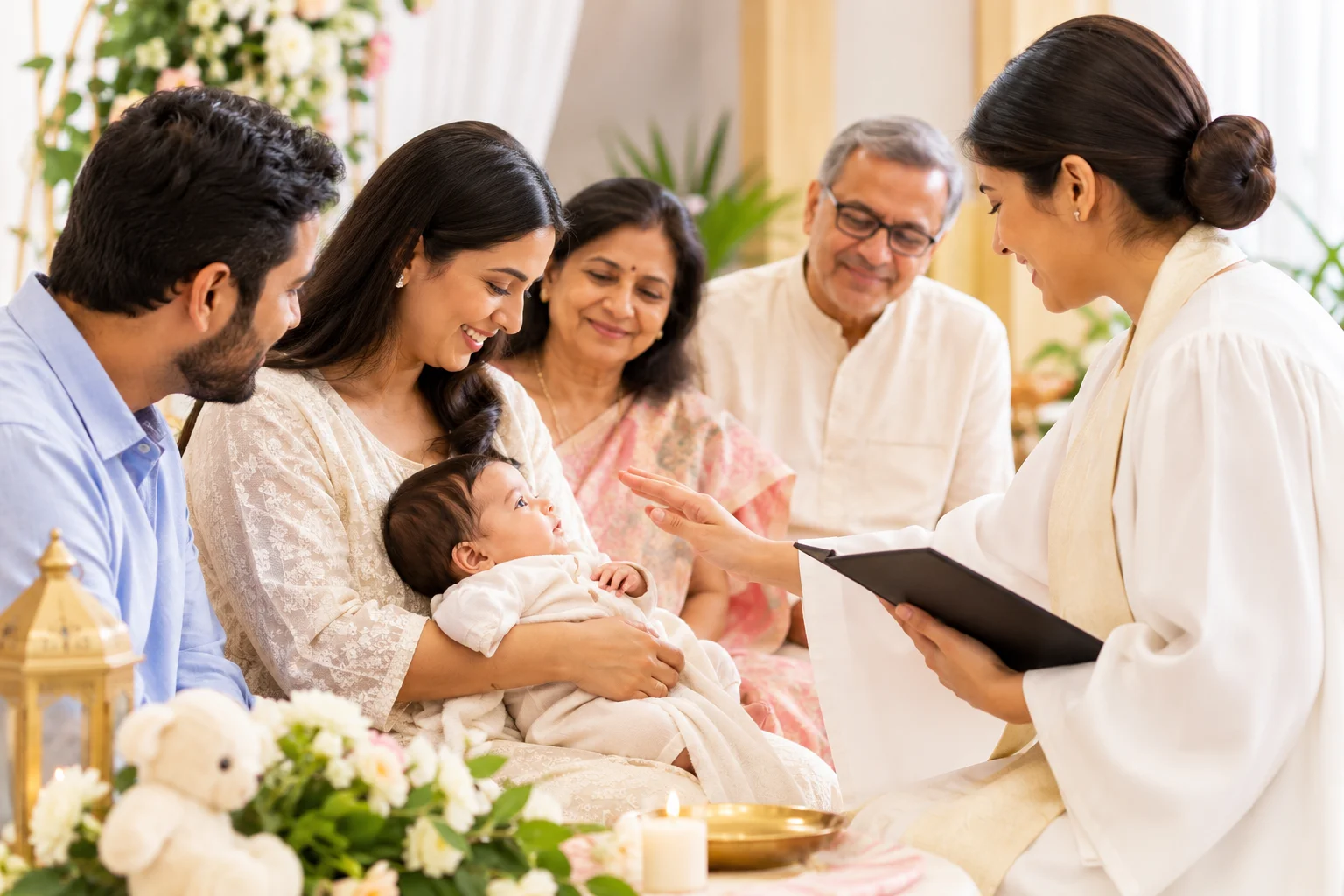
Anyone you trust can officiate a baby naming ceremony, because it has no legal status. Most families choose a professional or humanist celebrant, a registrar offering civil naming ceremonies, a religious leader, a grandparent or close friend, or the parents themselves. Pick the person who can speak warmly, keep the ceremony organised and reflect your family's beliefs.
You have chosen the name, picked a date and started the guest list. Then comes a question many parents do not see coming: who actually leads the baby naming ceremony? Unlike a wedding, a naming ceremony carries no legal requirements, so there is no single "correct" person. That freedom is lovely, but it can leave you wondering whether a grandparent, a professional celebrant, a religious leader, a close friend or the two of you should stand at the front. This guide walks through every realistic option, what each one brings to the day, how to decide, which questions to ask before you book and how to write the words if someone in the family will lead. You will also find a comparison table, a sample script, a ceremony program and a checklist.
What Does an Officiant Do at a Baby Naming Ceremony?
A baby naming ceremony is a celebration where parents welcome a child into their family and community, announce the baby's name and make promises for the years ahead. It is often chosen by families who want something more personal than a traditional religious service, but it is equally popular as an addition to one. The officiant (sometimes called the celebrant, host or master of ceremonies) is simply the person who guides everyone through it.
In practice, a good officiant does five things:
• Opens the ceremony by welcoming guests and explaining what the gathering is for.
• Sets the tone, whether that is warm and funny, quiet and spiritual or short and simple.
• Leads the key moments, including the name reveal, the parents' promises, readings and any ritual such as candle lighting or tree planting.
• Keeps time, so a ceremony planned for 20 minutes does not drift into an hour while the baby gets hungry.
• Brings in other people, calling grandparents, guide parents or siblings forward for their part.
Do you need a licence or ordination?
No. A naming ceremony is a personal, symbolic event. It is separate from birth registration, which is the legal step every family must complete, and it cannot be used to change a child's name officially. Local councils in the UK that offer civil naming ceremonies are explicit on this point: the ceremony and any commemorative certificate have no legal status, and the person leading it is not acting in an official capacity, even if they also work as a registrar. The same logic applies elsewhere. Because nothing legal depends on the ceremony, nobody needs special authority to lead it.
What does matter is that the person is comfortable speaking in front of a group, understands what you want and respects your family's beliefs.
How this differs from a christening or other religious naming
If you are comparing a naming ceremony vs christening, the officiant is the clearest difference. A christening is a religious sacrament led by clergy within a particular church, usually with set wording and set roles such as godparents. A naming ceremony can be fully secular, fully religious, or a blend, and the officiant is whoever you choose. Many faiths also have their own naming traditions, and those usually have an expected leader. We cover them below.
Who Can Officiate a Baby Naming Ceremony? Your Six Main Options
1. A professional celebrant (independent or humanist)
A celebrant is a trained ceremony leader who writes and conducts personalised ceremonies. Humanist celebrants, who lead non-religious ceremonies, were in fact the original creators of the modern secular naming ceremony, long before registry offices began offering their own versions.
Best for: parents who want a polished, personal ceremony without having to write or run it themselves, particularly when the guest list is large or family dynamics need careful handling.
• Pros: experienced with timing and public speaking, helps you shape the ceremony, can supply readings and promise wording, and usually meets you beforehand.
• Cons: this is usually the most expensive option, and good celebrants book up for popular weekends.
• Tip: ask to hear a sample ceremony or read reviews, as style varies from formal to very relaxed.
2. A registrar or civil ceremony service
In some countries, particularly in the UK, local registration services offer civil naming ceremonies in their ceremony rooms or at approved venues. These are typically led by a celebrant from the registration team. Councils generally describe them as secular, quick (often 15 to 30 minutes depending on the readings you choose) and accompanied by a commemorative certificate.
Best for: families who want a simple, affordable, ready-made format in a dignified setting.
• Pros: clear pricing, set structure, a keepsake certificate and no need to find your own officiant.
• Cons: many services do not allow religious content, venues may be limited to approved premises, and some ask to see the child's birth certificate when you book, so the birth must already be registered.
• Tip: check the rules on readings, music and guest numbers before you commit.
3. A religious or community leader
If your family follows a faith tradition, the natural officiant is often a priest, pastor, imam, rabbi, granthi, pandit or community elder. Customs differ widely, so always confirm details with your own community rather than assuming. As general examples:
• Hindu families often hold a naming rite (namakarana) led by a priest, commonly in the first weeks after birth, though timing varies by region and family custom.
• Sikh families typically take the baby to the gurdwara, where the name is chosen after a reading from the Guru Granth Sahib, guided by the granthi.
• Muslim families often announce the name at an aqiqah gathering, which is commonly held around the seventh day, with the father or an elder leading the prayers.
• Jewish families may hold a brit milah for boys and a baby-naming ceremony such as a zeved habat for girls, led by a rabbi or knowledgeable community member.
• Christian families usually arrange a christening or dedication led by clergy, sometimes followed by a separate family celebration.
Best for: families for whom faith is central, or who want the name given within their religious community.
• Pros: authentic traditions, a trusted community figure and meaningful ritual.
• Cons: the format may be fixed, and some clergy expect the family to be active members of the congregation.
• Tip: if you want a mixed-faith or interfaith ceremony, ask the leader early whether they are open to adapting it.
4. A family member or close friend
A grandparent, aunt, uncle or longtime friend can lead the ceremony beautifully, especially at a home or garden gathering. Many families like this option because it keeps the day intimate and honours someone who will be part of the child's life for years.
Best for: small, informal ceremonies where the person leading is already loved and trusted by everyone present.
• Pros: free, deeply personal and flexible.
• Cons: nerves, long speeches and awkward pauses are more likely without experience.
• Tip: give your chosen person a written script, a time limit and a rehearsal. The sample script below is designed for exactly this.
5. The parents themselves
Some parents prefer to lead their own ceremony, sharing the welcome, the name reveal and the promises between them. This can feel emotionally powerful because nobody stands between you and your child.
Best for: very small gatherings and families who want total control of the words.
• Pros: completely personal, no cost and no scheduling conflicts.
• Cons: you will be emotional, sleep-deprived and busy being the guests of honour, so managing the running order as well can be difficult.
• Tip: appoint a friend as a quiet "ceremony helper" to cue music, hold the baby for a moment or keep the timing.
6. A shared or hybrid approach
You do not have to choose only one. Many families split the role, and this often works better than one person carrying everything:
• A celebrant leads the formal parts while a grandparent gives a blessing and a sibling reads a poem.
• A religious leader performs the rite, then a friend hosts a more relaxed naming celebration at home.
• The parents reveal the name themselves, while a friend acts as master of ceremonies for everything else.
Officiant options at a glance
|
Option |
Typical cost |
Religious content |
Effort for parents |
Best suited to |
|
Professional celebrant |
Highest |
Optional, as you choose |
Low |
Personalised ceremonies of any size |
|
Registrar or civil service |
Fixed fee |
Often not permitted |
Low |
Simple, secular, structured events |
|
Religious leader |
Often a donation or none |
Central |
Medium |
Faith-based naming |
|
Family or friend |
Free |
Optional |
Medium to high |
Small, intimate gatherings |
|
Parents |
Free |
Optional |
High |
Very small, private ceremonies |
|
Hybrid |
Varies |
Optional |
Medium |
Blended families and traditions |
Costs and rules vary by country, venue and provider, so treat this table as a starting comparison and confirm details locally.
Questions Parents Often Ask About Who Leads the Ceremony
Can a godparent or guide parent officiate?
Yes, if you want them to. In a traditional christening, godparents have a defined role alongside the clergy. In a secular naming ceremony, "guide parents", "supporting adults" or "mentors" usually make promises of friendship and support rather than lead the ceremony. Having one of them act as officiant is a lovely way to deepen that bond, as long as they are comfortable speaking.
Can the officiant be non-religious if the guests are religious?
Absolutely. A secular officiant can create a ceremony that respects everyone's beliefs, for example by including a short reading or blessing from a grandparent. Telling your officiant about guests' backgrounds ahead of time helps them choose wording that feels welcoming to all.
Who announces the name at a baby name revealing ceremony?
In many families, the name reveal is the emotional high point, so the choice of who says it matters. Common options are the parents together, the officiant after a short build-up, or a grandparent who shares the story behind the name. If you want a name revealing ceremony with a surprise element, rehearse the moment so the officiant knows exactly when to pause.
Many parents also like to explain why they chose the name, whether it honours a relative, carries a meaning or reflects their cultural roots. If you are still finalising the name and want ideas with meaning behind them, Jollynames.ai offers tools for exploring names by theme, tradition and personal preference.
Can we hold the ceremony before the birth is registered?
Technically the ceremony itself is not legal, so you can hold it at any time. However, some registration services require the birth certificate to book a civil ceremony, and a religious leader may follow their own timetable. Check requirements early, and complete the official birth registration according to your local rules regardless of when the ceremony takes place.
Can the ceremony change my child's name?
No. Councils that offer naming ceremonies state clearly that a ceremony cannot be used to change a child's name. If you want a different official name, follow your local legal process first, then celebrate it publicly.
How to Choose the Right Officiant for Your Family
Instead of asking "who is allowed?", ask "who fits our day?" Work through these questions in order:
1. What atmosphere do we want? Formal and reverent, warm and chatty or playful and light? Your answer immediately narrows the field.
2. How important is religion or tradition? If a faith ritual is essential, begin with your religious leader. If you want it secular, look at celebrants or registrars.
3. How many guests are coming? Larger groups usually benefit from an experienced speaker. Under 15 people, a family member can work very well.
4. What is our budget? Decide your limit before you start contacting people so you can compare fairly.
5. Who can the baby's story honour? Sometimes the best officiant is the grandparent who will tell the child "I was there the day you were named".
6. How much do we want to do ourselves? Be honest about your energy levels in the first months of parenthood.
Quick matching guide
|
If this sounds like you... |
Consider... |
|
"We want a beautiful ceremony but have no time to plan it." |
A professional celebrant or registrar |
|
"Our faith is central and we want the community involved." |
Your religious leader, with family readings |
|
"We are hosting 12 people in our garden." |
A grandparent, friend or the parents, using a script |
|
"We come from two different traditions." |
A hybrid ceremony, or a celebrant experienced in interfaith ceremonies |
|
"We are on a tight budget." |
A family member or friend, with a rehearsal and a printed order of service |
|
"We are welcoming an adopted or stepchild." |
A celebrant or trusted loved one who can speak sensitively about your family's story |
Planning Tips and Common Mistakes
Questions to ask before booking a celebrant or leader
• What is your fee, and what does it include (meeting, script, rehearsal, certificate, travel)?
• Are you available on our date and at our venue?
• Can you include our religious or cultural elements, or keep the ceremony fully secular?
• Do you meet with the family beforehand, and how much of the wording can we change?
• How long will the ceremony last, and how do you handle a crying or restless baby?
• Have you led ceremonies for blended families, adopted children or two-faith families?
• What is your cancellation and rescheduling policy?
Common mistakes to avoid
• Assuming a legal step is involved. Birth registration is the legal requirement. The ceremony is symbolic.
• Choosing an officiant who is not comfortable speaking. Affection is not the same as stage confidence. Offer a co-host or a script if needed.
• Leaving the script until the last minute. Write it at least two weeks ahead so everyone can read it aloud once.
• Overpacking the program. Short ceremonies feel more special. For a baby, 15 to 30 minutes is usually plenty.
• Forgetting a back-up. If your chosen speaker is unwell on the day, have a second person who has seen the script.
• Not briefing the officiant on sensitivities. Mention estranged relatives, recent losses or how you want the baby's name pronounced.
• Ignoring baby's schedule. Plan around naps and feeds, and keep the formal part before the meal.
Ready-to-Use Scripts, Program and Checklist
Sample ceremony script for a family or friend officiant
Adapt the wording freely. Square brackets show where to add your own details.
Welcome
"Good afternoon, everyone, and thank you for being here. We have come together today to celebrate the arrival of [baby's nickname or placeholder] and to welcome them into a circle of people who already love them very much. My name is [name], and I am honoured to have been asked to lead this ceremony."
The name reveal
"Every child begins as a hope, and today that hope receives a name. [Parent 1] and [Parent 2], would you share with us the name you have chosen?"
(Parents announce the name and, if they wish, say a few words about why they chose it.)
"[Full name], welcome. We are so glad you are here."
Parents' promises
"[Parent 1] and [Parent 2], do you promise to love [Name], to listen to them, to protect them and to help them grow into the person they are meant to be?" Parents: "We do."
Promises from guide parents, grandparents or friends
"Will you, as part of [Name]'s circle of care, offer your friendship, your guidance and your support throughout their life?" Supporters: "We will."
Reading or ritual
Invite a guest to read a short poem or blessing, or light a candle, plant a sapling, or add a handprint to a keepsake.
Closing
"[Name], today you were named in love, surrounded by family and friends. May you always remember how many people stood beside you at the very beginning. Thank you all for sharing this day with us."
Sample naming ceremony timeline and program
|
Time |
Segment |
Who leads |
|
0:00 |
Guests arrive, background music |
Parents or helper |
|
0:10 |
Welcome and introduction |
Officiant |
|
0:13 |
Story behind the name and name reveal |
Parents and officiant |
|
0:18 |
Parents' promises |
Parents, led by officiant |
|
0:22 |
Guide parent and grandparent promises |
Supporters |
|
0:26 |
Reading, blessing or ritual |
Guest or officiant |
|
0:30 |
Closing words and photo moment |
Officiant |
|
0:40 |
Food, cake and mingling |
Everyone |
If your ceremony is held at home, you may prefer to keep the program to 20 minutes and move straight to food.
Officiant checklist
• Decide your preferred style: secular, religious or blended.
• Set a budget and shortlist two or three possible officiants.
• Confirm date, venue, duration and fee in writing.
• Share the guest list notes, name pronunciation and any sensitivities.
• Agree the script, who says what, and who will read or perform.
• Rehearse once, including the name reveal moment.
• Arrange a back-up speaker and a copy of the script for them.
• Prepare any certificate, candle, plant or keepsake needed.
• Check requirements such as a birth certificate if using a civil service.
• Confirm the final timings with the officiant a week before.
Frequently Asked Questions
Who can officiate a baby naming ceremony?
Anyone you trust. Common choices are professional or humanist celebrants, registrars offering civil naming ceremonies, religious leaders, grandparents or friends, and the parents themselves. There is no legal requirement for the person to be licensed or ordained.
Does a naming ceremony officiant need to be licensed?
No. A naming ceremony has no legal status, so a licence is not needed. Some registration services use trained celebrants, and religious leaders follow their own traditions, but a family member can lead a ceremony equally validly.
Can a friend or family member officiate?
Yes. This is very common for home and garden ceremonies. Choose someone confident at speaking, give them a script and rehearse the key moments together.
Can a naming ceremony be religious?
It can be. Private ceremonies and those led by religious leaders can include prayers, readings and rituals. Some council-run civil ceremonies are strictly non-religious, so check the rules if you are booking through a registration service.
How long does a baby naming ceremony take?
Most last around 15 to 30 minutes, depending on how many readings, promises and rituals you include. Allow extra time afterwards for photos and food.
How much does it cost to hire an officiant?
It varies widely. A family member costs nothing, a religious leader may ask for a donation or nothing at all, and celebrants and registration services charge fees that depend on location, day and venue. Ask for a written quote.
Can we hold a naming ceremony for an older child?
Yes. Many services and celebrants state that children of any age can have a naming ceremony, which can be meaningful for adopted children and stepchildren joining a family.
Is a naming ceremony legally binding?
No. It is a public expression of love and commitment, not a legal event. Registering the birth is the legal step, and the ceremony cannot change the official name or be used as identification.
Who usually announces the baby's name?
Usually the parents, either on their own or alongside the officiant. Some families ask a grandparent to announce it instead, especially when the name honours an ancestor.
The best person to officiate a baby naming ceremony is not the one with the most impressive title. It is the person who makes you and your guests feel relaxed, welcomed and a little moved. A celebrant brings structure, a religious leader brings tradition, a grandparent brings love and history, and you as parents bring the heart of the day. Decide on the tone you want, choose accordingly, share a clear script and leave room for the baby to be, well, a baby.
Once you have your officiant and your date, the name itself deserves the same care. If you are still exploring options or want to find a name with a meaning, a cultural connection or a story you can share at the ceremony, Jollynames.ai can help you discover and explore baby names that feel right for your family.