10 Things to Check Before You Finalize Your Baby's Name
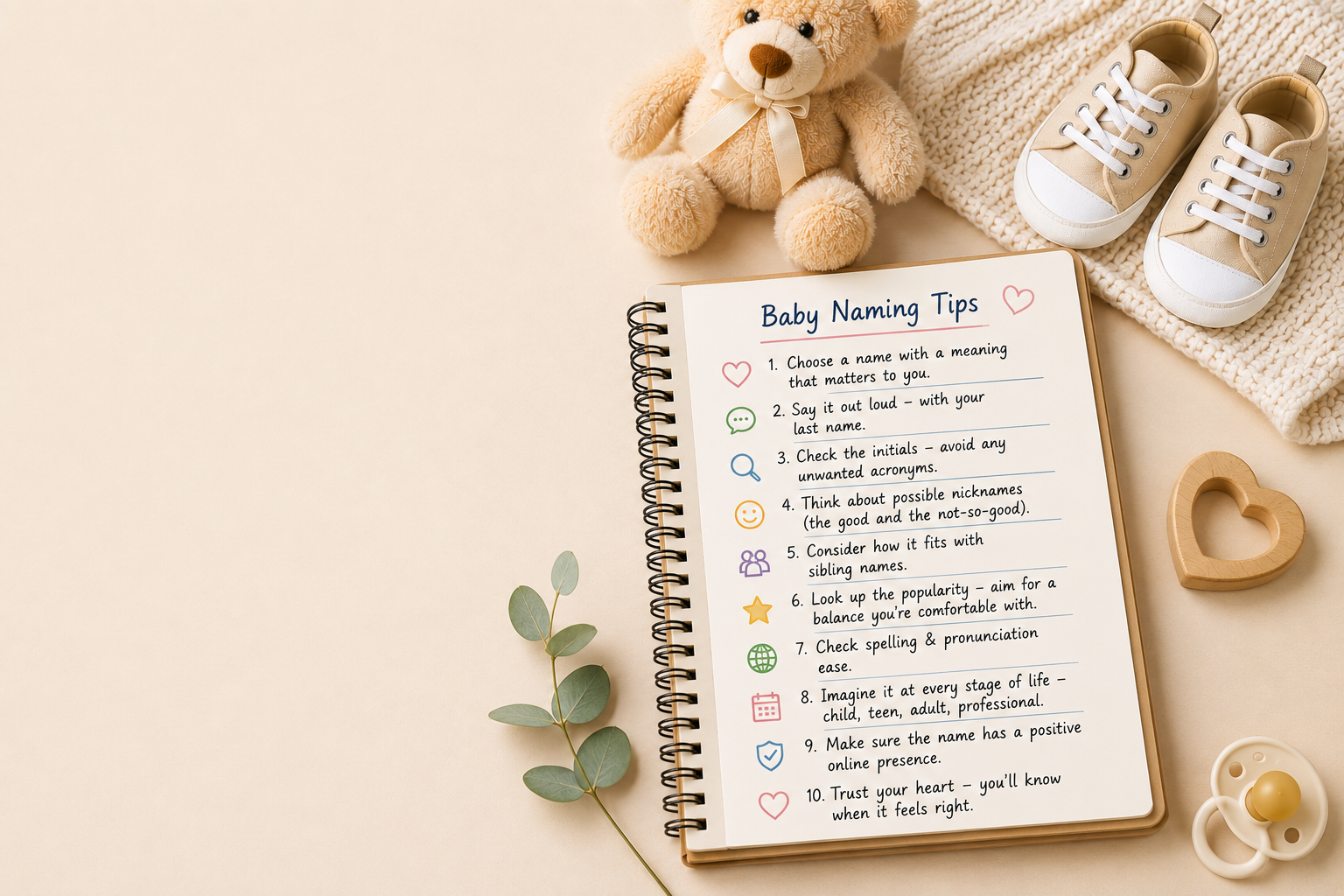
Before finalizing your baby's name, check: meaning and origin, spelling and pronunciation ease, the initials together, likely nicknames, cultural or religious significance, how it sounds with your last name, its popularity trend, sibling name compatibility, its online presence, and how it sounds said aloud in full, repeatedly.
1. Meaning and origin
2. Spelling and pronunciation ease
3. The initials test
4. Possible nicknames
5. Cultural, religious, and family significance
6. How it sounds with your last name
7. Popularity trends
8. Sibling name compatibility
9. Online presence and global perception10. The “say it out loud, many times” test
You've narrowed it down to “the one.” It sounds beautiful, it feels right, and you're ready to write it on the paperwork. But here's the thing about baby names: unlike almost every other decision you'll make as a parent, this one is nearly impossible to undo. You can switch pediatricians, return the wrong-size onesie, and repaint the nursery a hundred times — but a name, once it's on the birth certificate, tends to stick for the next 80-plus years.
That permanence is exactly why so many parents get partway through the naming process, feel good about a shortlist, and then freeze. The uncertainty isn't usually about whether the name is “pretty enough.” It's about all the things that are hard to picture in advance: How will it sound when a teacher reads it out at a graduation in 22 years? What will kids on the playground do with it? Will it still feel distinctive in a decade, or will it be one of five in every kindergarten class?
This guide walks through the 10 practical checks worth running before you finalize your baby's name — the kind of checklist that turns a gut feeling into a confident decision. None of these take more than a few minutes individually, but together they catch almost everything parents later wish they'd thought of sooner.
1. The Actual Meaning and Origin
A name can sound lovely and still carry a meaning you wouldn't choose on purpose. Names meaning “bitter,” “sorrow,” “war,” or “mourning” show up more often in baby name databases than most parents expect, often hidden behind a sound that's genuinely beautiful in English or another language. Look up the etymology, not just the vibe.
This matters for a second reason too: many names carry very different meanings across cultures and languages. A name that sounds elegant and neutral in English might be a common word for something unflattering in another language your child could encounter while traveling, studying abroad, or simply meeting people online. A five-minute search across a couple of languages avoids a lifetime of minor embarrassment.
Beyond avoiding a poor meaning, understanding the origin also gives the name a story. Parents often find that once they know why a name means what it means — a virtue, a nature element, a family lineage, a historical figure — it becomes even more meaningful to say out loud, and it gives your child something to be genuinely proud of when they eventually ask, “Why did you name me this?”
2. Spelling and Pronunciation Ease
Ask yourself honestly: will your child spend their whole life correcting how people say or spell this name? There's nothing wrong with a distinctive name, but it helps to know upfront whether you're choosing “distinctive” or “guaranteed daily correction.” Some parents are completely fine with the trade-off — a unique name is often worth a little extra spelling out. Others would rather avoid it entirely. Either is valid, as long as it's a conscious choice rather than a surprise.
A useful test: say the name out loud to a friend or relative who has never heard it before, and ask them to spell it back without seeing it written. If they get it wrong, that's a preview of what substitute teachers, delivery drivers, customer service reps, and every new acquaintance will do for the rest of your child's life. It's also worth typing the name into a few common government and school-enrollment style forms mentally — does it fit standard character limits? Does it use any characters or accents that might get stripped by outdated systems?
None of this means you should default to the safest, most common spelling. It just means going in with eyes open about how much explaining the name will require, so it's a decision you're making rather than one you're stumbling into.
3. The Initials Test
This is the check that gets skipped more than any other, and it's the one that comes back to haunt parents hardest. Write out the first, middle, and last name initials together, exactly as they'll appear on monograms, luggage tags, school uniforms, and yearbooks. Names that are perfectly lovely on their own can combine into something unfortunate once you line up the initials — a set of letters that spells out a word nobody wants embroidered on a backpack.
Do this check before the middle name is locked in, not after. It's common for parents to settle on a first and last name early, feel confident, and then rush the middle name choice at the very end — which is exactly when the initials test gets skipped. Take the extra five minutes here. It is, without question, one of the most common regrets parents mention after the fact.
4. What Nicknames It Could Turn Into
Kids on a playground will shorten, twist, rhyme, and remix almost any name — that's simply what happens once school starts. Before finalizing a name, brainstorm every nickname classmates might land on, including the unflattering ones, not just the cute ones you have in mind.
If you love the nickname a name naturally produces — Alexander to Alex, Elizabeth to Ellie or Liz — that's a bonus, since it effectively gives your child two names to grow into. But if a name has an obvious unfortunate nickname baked in, it's worth knowing that now, while you can still adjust, rather than discovering it in third grade when it's already stuck. It also helps to consider the reverse: some parents pick a name specifically because of the nickname it produces, only to realize later that the full formal name doesn't feel quite right for a job application or a wedding invitation twenty-five years down the line. Check that both the full name and its likely shortened form feel right to you.
5. Cultural, Religious, and Family Significance
Names often carry weight far beyond how they sound. Many carry religious significance, appear in sacred texts, or are tied closely to specific ancestral naming traditions — first-born naming customs, patronymics, or names reserved for particular family roles. Others are deeply tied to a specific culture, region, or language, carrying meaning that isn't always obvious from a quick internet search.
If the name you're considering comes from a heritage other than your own, a little extra research — or simply asking someone from that background — goes a long way toward making sure it's being used respectfully and accurately, rather than borrowed purely for aesthetics. This is especially worth doing thoughtfully in 2026, as more parents blend cultural traditions in multicultural families and want the name to genuinely honor both sides of a child's heritage rather than feel like decoration.
On the family side, it's also worth checking whether the name carries private significance — a beloved grandparent, a family member who passed away, an inside joke, or a name already used by a close relative's child. These aren't dealbreakers, but they're worth discussing openly with both sides of the family before the announcement, so nobody feels surprised or overlooked.
6. How It Sounds With the Last Name
A first name is never chosen in true isolation — it's paired with a surname for the rest of your child's life, on every form, every introduction, and every professional email signature to come. Say the full name out loud, several times, in a few different tones: casually, as you would introducing your child to a stranger; formally, as it might be read out at a graduation; and sternly, as if you're calling your child in from the yard at dinnertime.
Listen specifically for repeated sounds (Laura Lawrence), rhymes that feel more like a nursery rhyme than a name (Jack Mack), or a syllable count that makes the whole name a mouthful to say quickly. Also check the ending sound of the first name against the starting sound of the last name — names that blur together (Michael Elliott becoming “Michaelliott” when said fast) are easy to miss when reading silently but obvious the moment they're spoken aloud.
7. Popularity Trends — Both Directions
Check where the name currently sits on national and regional popularity charts, and pay attention to the trend line, not just the current snapshot. A name climbing fast up the rankings might be in the top 200 today and the top 20 by the time your child starts kindergarten, thanks to a popular show, celebrity baby, or viral trend. A name in the top 10 already means your child will likely share a classroom with two or three others with the exact same name.
On the other end, a name far outside the top 1,000 means near-constant explanation, correction, and the occasional assumption that it's misspelled. Neither extreme is wrong — some parents actively want a name shared with a beloved public figure or family tradition, and others specifically want something no one else in the class will have. The point of checking is simply to choose deliberately rather than be surprised either way.
|
Popularity Range |
What to Expect |
Good For Parents Who Want... |
|
Top 10 nationally |
Likely to share the name with 2-3 classmates; very familiar to teachers and relatives |
A timeless, easy, universally recognized name |
|
Top 100–500 |
Recognizable but not overly common — a common sweet spot for most parents |
Balance between familiar and distinctive |
|
Outside top 1,000 |
Distinctive; expect frequent spelling and pronunciation questions |
A name that stands out and feels one-of-a-kind |
8. Sibling Name Compatibility
If you already have children, or plan to have more, consider how the names sound as a full set, not just individually. Wildly mismatched styles — one very traditional and formal, one very modern and invented — can feel disjointed when the names are called out together, listed on school forms, printed on holiday cards, or read off a family tree years from now.
This doesn't mean sibling names need to rhyme, share a letter, or match a theme exactly. Plenty of families happily mix styles. But it's worth the simple exercise of saying all your children's names in a row, out loud, and noticing how they sit together as a group. If one name feels noticeably more elaborate or noticeably plainer than the others, it's worth asking whether that's an intentional choice or just an oversight from focusing on each name separately.
9. Online Presence and Global Perception
A quick search of the name reveals more than most parents expect. It surfaces existing public figures who share the name — which may or may not be an association you want — as well as its availability as a social handle, email address, or domain name, which matters more to some families than others depending on how online-native you expect your child's generation to be.
It's also worth checking how the name reads or sounds in a few other major languages, especially if your family travels often, has international relatives, or lives in a multicultural or multilingual community. A name that's lovely and completely neutral in English can occasionally be a common slang term, an awkward homophone, or simply very difficult to pronounce in another widely spoken language. None of this needs to be a dealbreaker on its own, but it's far better to know about it in advance than to find out from a well-meaning stranger years later.
10. The “Say It Out Loud, Many Times” Test
Finally, the simplest and most underrated check of all: say the full name out loud, repeatedly, over the course of a few days, not just once in the hospital room or over dinner. Say it happily, the way you'd call out to your child across a park. Say it sternly, the way you might if they've wandered off. Say it formally, the way a teacher would read it from a class roster on the very first day of school.
Names that look perfect written down sometimes feel completely different once they've actually been spoken a hundred times in a row — a rhythm that reads smoothly on paper can suddenly feel clumsy out loud, or a name that seemed slightly unusual in your head turns out to roll off the tongue beautifully once you actually say it. This is the test that tends to catch what every other check on this list misses, simply because names are, at the end of the day, meant to be spoken far more often than they're meant to be written.
Putting the Checklist Into Practice
If ten separate checks feel like a lot to hold in your head at once, it helps to spread them across two or three short sessions rather than trying to do everything in a single sitting. A simple approach many parents find useful:
● Session 1: Meaning, origin, cultural significance, and pronunciation ease — the research-heavy checks.
● Session 2: Initials, nicknames, and how the name sounds with your last name and any siblings — the “say it out loud” checks.
● Session 3: Popularity trends and online presence — the checks that benefit from a quick search.
By the end of three short sessions, you'll have either confirmed that your favorite name genuinely holds up, or identified exactly which part of it needs a second look — a middle name that clashes, a nickname you hadn't considered, or a spelling that's slightly harder to say than it looks on paper. Either outcome is progress, and either way, you'll finalize the name with real confidence instead of a last-minute leap of faith.
Frequently Asked Questions
What should I check before finalizing my baby's name?
Check its meaning and origin, spelling and pronunciation ease, how the initials look together, possible nicknames, cultural or religious significance, how it sounds with your last name, its popularity trend, sibling name compatibility, its online presence, its international perception, and how it sounds said aloud in full.
How do I know if a baby name is too popular or too unique?
Compare it against recent national and regional baby name ranking data. Top-10 names are highly common and likely to be shared with classmates; names outside the top 1,000 are considered rare and may require frequent spelling or pronunciation clarification. Many parents aim for a middle ground — recognizable but not overly common.
Why do baby name initials matter?
Initials can accidentally spell out awkward or embarrassing words once the first, middle, and last names are combined — something classmates, teachers, and colleagues will notice for life on monograms, uniforms, and paperwork. Always write out the full set of initials before finalizing a middle name.
Should I Google a baby name before choosing it?
Yes. A quick search reveals existing public figures associated with the name, its meaning or connotations in other languages, and its availability as a social media handle or domain — all details that are far easier to check now than to change later.
What is the best way to test if a baby name “flows” with the last name?
Say the full name — first, middle, and last — out loud in a few different tones, including a casual introduction, a formal graduation-style reading, and a stern “calling them in for dinner” voice. Awkward rhythm, repeated sounds, or accidental rhymes are far more obvious when spoken than when simply read on paper.
How many baby names should I shortlist before finalizing one?
Most parents find 3 to 5 strong contenders is enough to run through a full checklist without becoming overwhelmed. Having too many options tends to make every check feel inconclusive, while too few can mean settling before you've had the chance to compare alternatives.